
Views: 39 Author: Site Editor Publish Time: 2026-07-06 Origin: Site


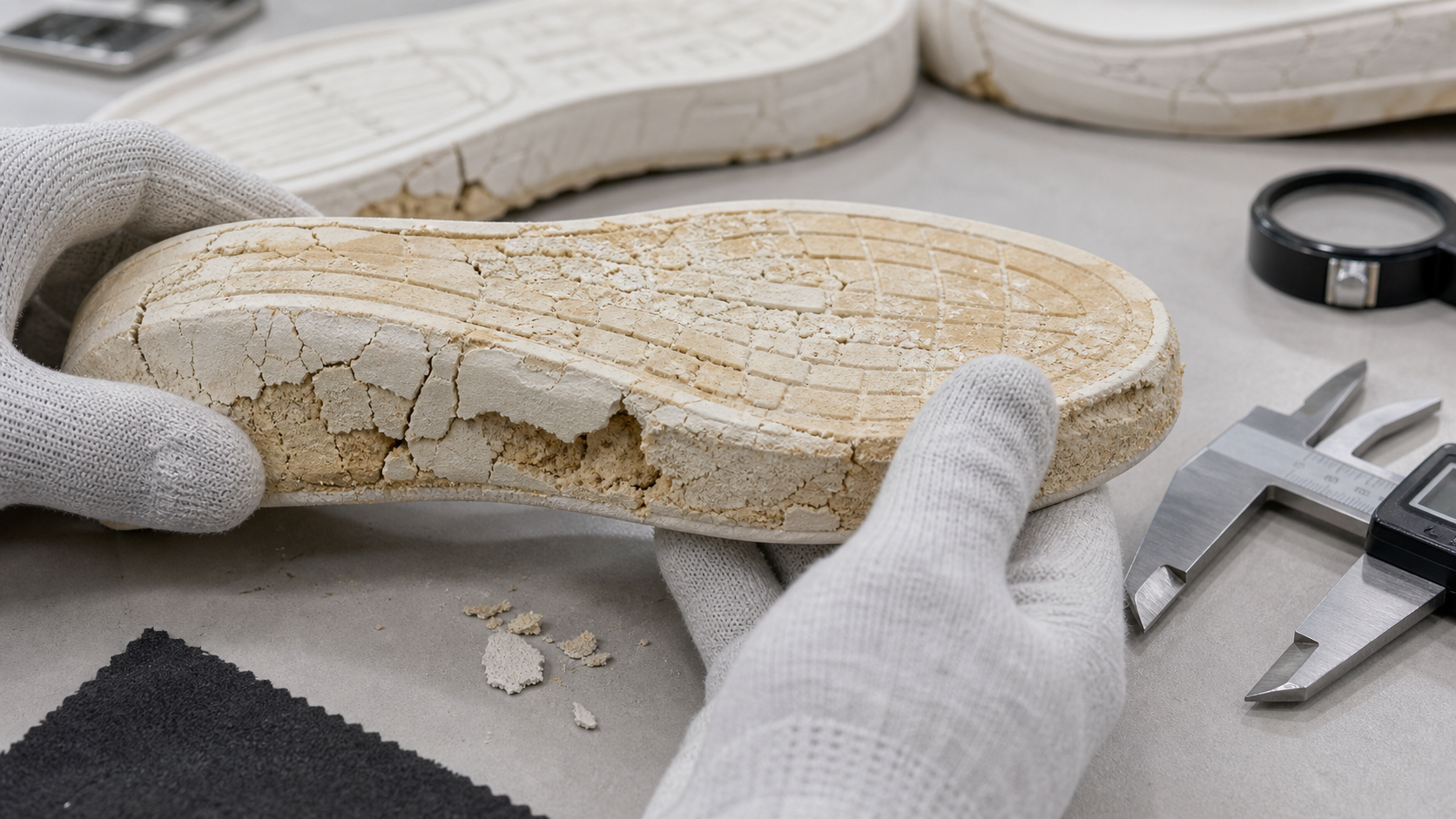
You opened cartons for the new season and the soles crumbled in your hands — cracked at the flex zone, chalky at the edges, some literally turning to powder. The shoes never touched a foot. They failed sitting on a shelf.
This is polyurethane hydrolysis, and it is one of the most expensive and most predictable failures in the footwear business. Predictable, because the chemistry is well understood. Expensive, because by the time you see it, the goods have usually been paid for, the claim window in your contract has closed, and the factory will tell you it's a "storage problem." This article explains what actually happened, which corner was probably cut, how to test for it before shipment, and how to structure your PO so the loss doesn't land on you.
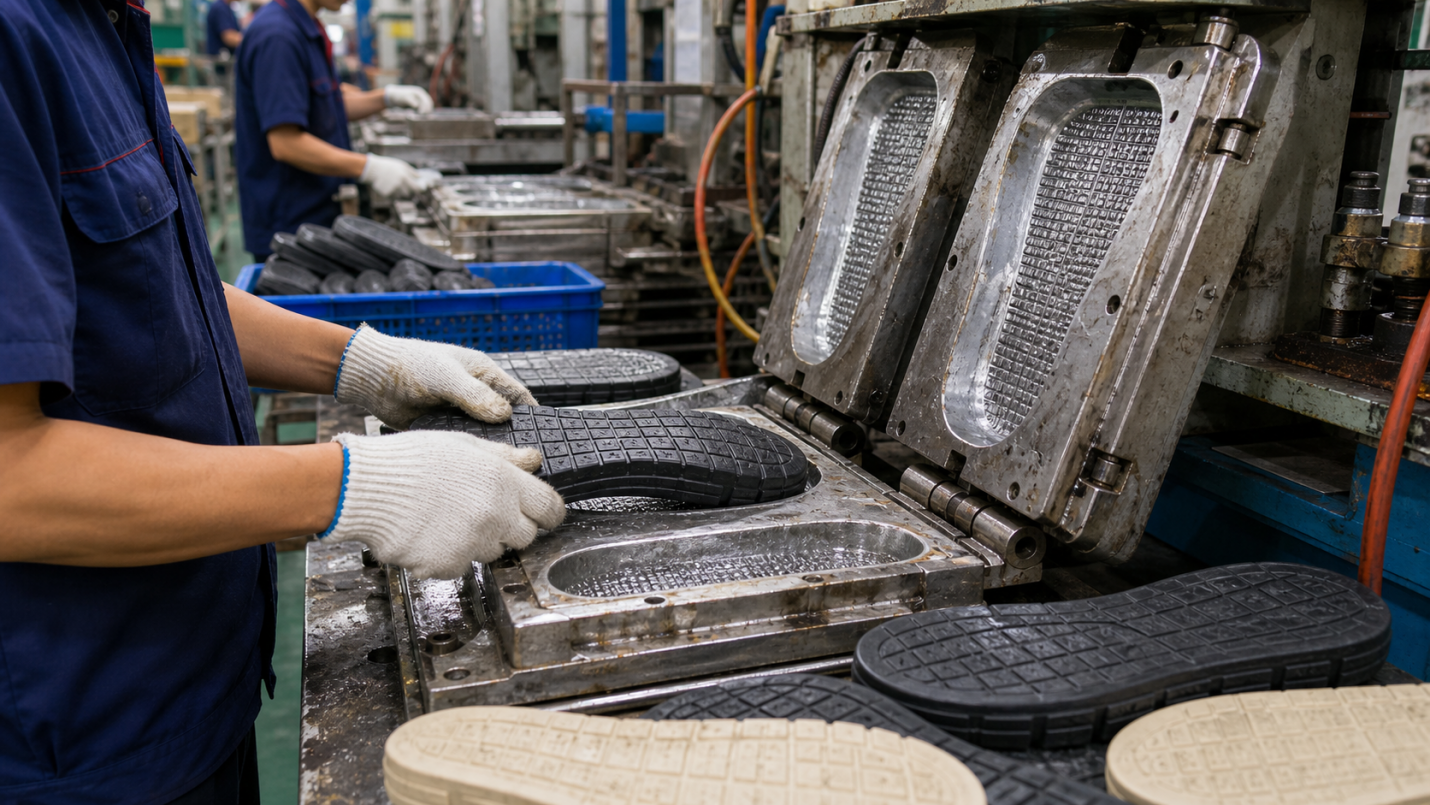
What Hydrolysis Actually Is — and Why It Happens on the Shelf
Most footwear PU soles are made from polyester-based polyurethane. The ester bonds in the polymer backbone react with moisture in the air and slowly break apart. No load, no flexing, no UV needed — ambient humidity is enough. The reaction is autocatalytic: the acid by-products accelerate further breakdown, which is why a sole can look fine at 14 months and disintegrate at 18.
Three factors set the speed of the clock:
Temperature and humidity. As a working rule, every 10°C increase roughly doubles the reaction rate. A sealed container crossing the equator, or a non-climate-controlled warehouse in Southeast Asia, the Gulf, or a Florida summer, can burn through a year of "shelf life" in a few months. Shoes sealed in poly bags inside cartons trap migrated moisture and make it worse.
Polyol type. Polyester PU has better abrasion resistance and mechanics but poor hydrolysis resistance. Polyether PU resists hydrolysis far better but costs more and gives up some abrasion performance. Most volume production uses polyester systems because of cost — which is fine, if the system is stabilized and the goods move through the chain fast enough.
Stabilizer package. Carbodiimide-type anti-hydrolysis additives (the class most people know by trade names like Stabaxol) at roughly 1–2% of the polyol can extend usable life significantly. This additive is invisible in the finished sole and adds real cost per pair. That combination — invisible plus costly — is exactly where corners get cut.
The clock starts at production, not at shipment
A polyester PU sole has a practical life of roughly 2–5 years from the date it was molded, depending on system quality and storage. Here is the trap: if your supplier molded soles three months before assembly, the shoes sat one month in the factory, four weeks on the water, and six months in your DC, your "new" inventory is already more than a year into its life before the first pair sells. If the factory used aged sole stock from a cancelled order — it happens more than anyone admits — you may have received goods with half their life already gone.
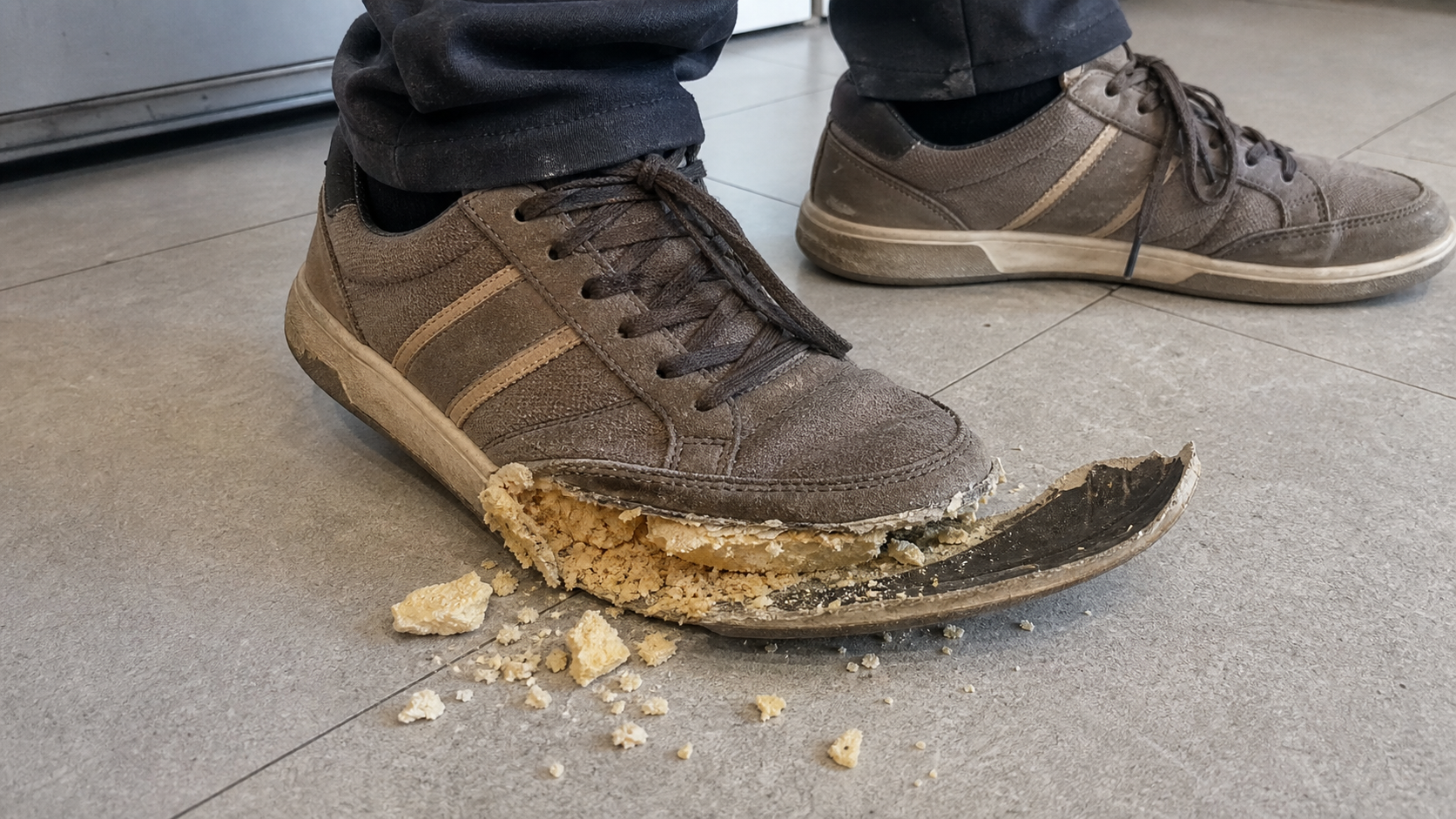
The Corner That Was Probably Cut
When hydrolysis failure shows up unusually early (under ~18 months), the root cause is almost always one of these:
1. Stabilizer dropped or under-dosed. The single most common cost cut. The sole demolds identically, passes visual QC identically, and fails 12 months later.
2. Cheap polyester system with high acid value. Low-grade polyols with residual acidity self-accelerate hydrolysis from day one.
3. Old sole inventory used for your order. No production date stamped inside the sole means no way to prove it.
4. Moisture in processing. Poorly dried raw material or high-humidity molding conditions build hydrolysis-prone weak points into the part.
None of these are detectable by squeezing the sole at inspection. That is why this failure mode has to be controlled by spec, test, and paperwork — not by eyeballing.
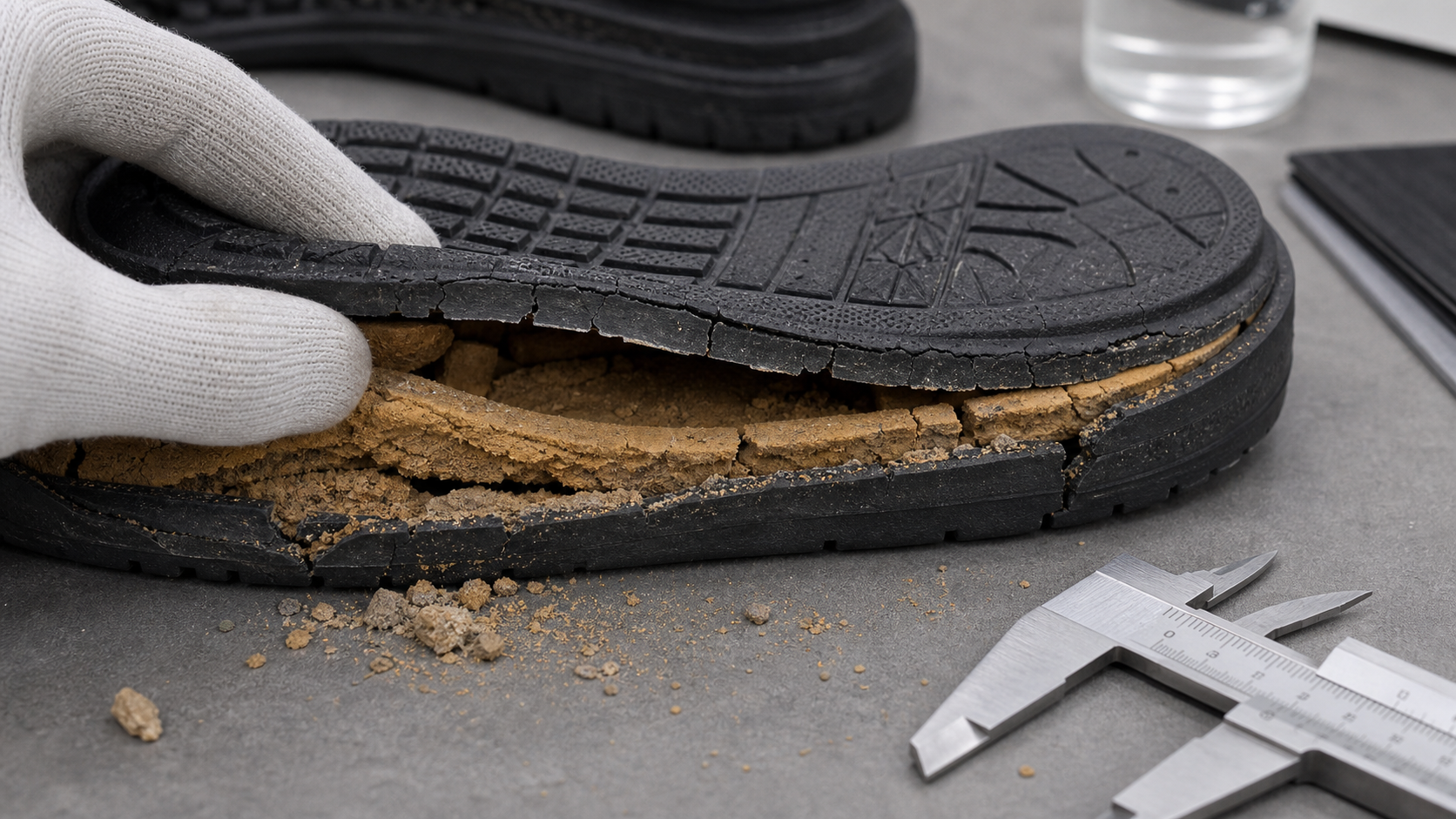
How to Catch It Before the Goods Ship
The industry-standard screen is an accelerated ageing / hydrolysis test: sole samples are conditioned at 70°C and ~100% relative humidity for 7 days, then flexed (e.g., Ross flex or bent around a mandrel) and checked for cracking. SATRA TM344 is the commonly cited method; EN ISO 20344 contains related ageing procedures used for safety footwear. Seven days at 70°C/100% RH approximates years of tropical warehouse exposure. A properly stabilized system passes; a stripped-down one cracks or crumbles.
What a serious buyer specifies:
Control point | What to require | Why it matters |
Polyol system | Named system + polyester/polyether declared on the spec sheet | Locks the recipe; prevents silent substitution |
Anti-hydrolysis additive | Carbodiimide stabilizer, dosage declared (typically 1–2%) | The most commonly cut ingredient |
Hydrolysis test | 7 days, 70°C/100% RH + flex test, report per production batch | Only reliable pre-shipment screen |
Production date | Molded date stamped or coded inside each sole | Proves age; kills the "old stock" trick |
Retention samples | Sealed pairs held by both sides, dated | Evidence base for any later claim |
Density check | PU outsole density on spec (commonly ~0.55–1.1 g/cm³ depending on construction) | Catches over-blown, cost-cut foam |
Storage terms | FIFO, <25°C, <65% RH, no sealed poly bags long-term, desiccant in cartons | Preserves the life you paid for |
The batch test report matters more than any certificate the factory shows you from two years ago. Systems drift; suppliers change polyol vendors without telling you.
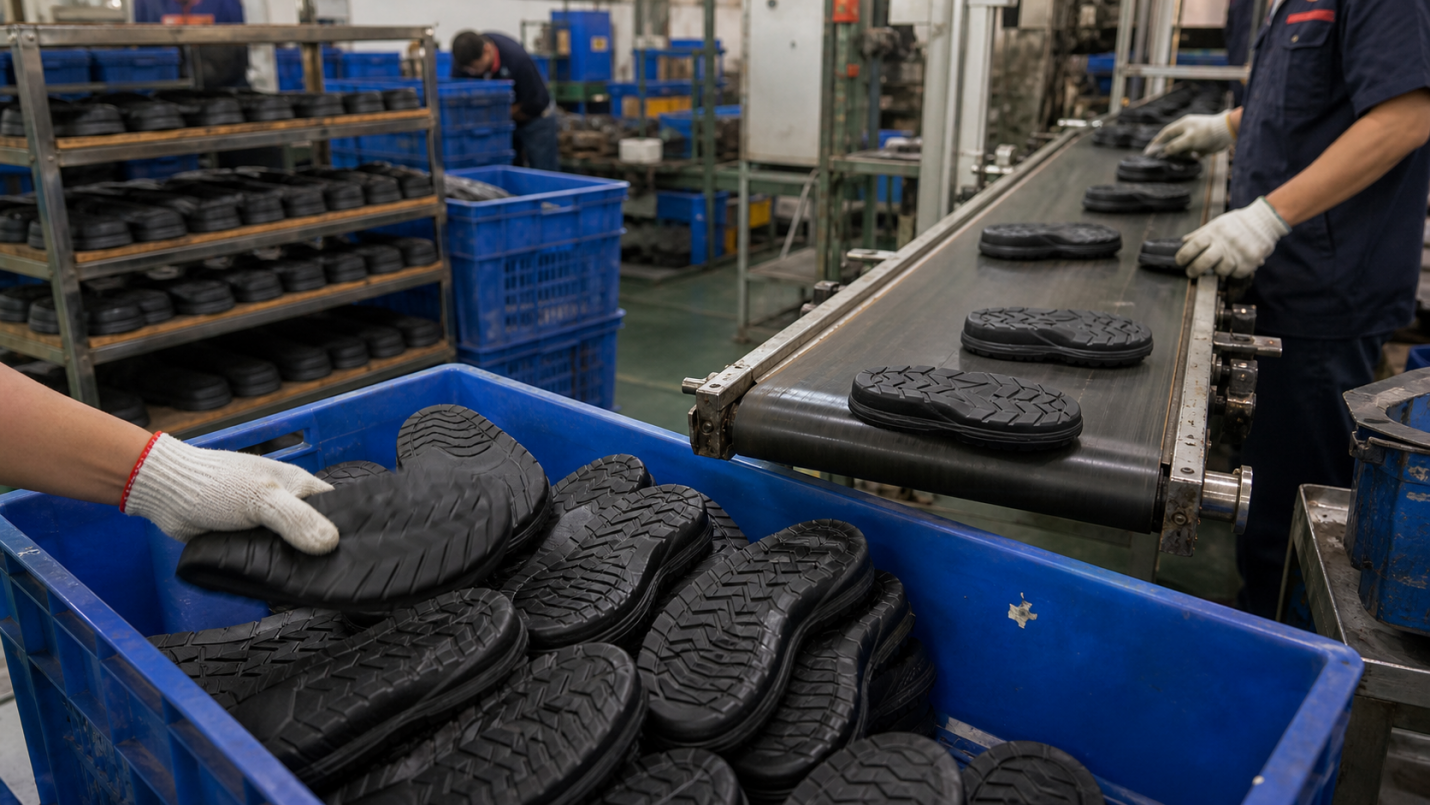
Who Pays When It Happens Anyway
This is where most buyers lose. The factory's first defense is always the same: "You stored them wrong." Liability in practice comes down to what your PO and spec sheet said — or didn't say.
• No spec, no test requirement, no production date: commercially, you own the loss. Most sale contracts limit claims to 6–12 months after shipment, and hydrolysis politely waits until month 14.
• Spec named the system and stabilizer, batch test reports exist, retention samples held: now you have leverage. An independent lab (SATRA, Intertek, SGS) can test your retained samples; if the retained, correctly stored pair also fails accelerated ageing, the defect was built in at production and the storage defense collapses.
• Production date stamped in the sole: if soles were molded long before your PO date, you have documentary proof of old stock.
Practical contractual levers to add to your next PO: a latent defect clause carving hydrolysis out of the standard claim window (24–36 months from production date), a requirement that soles be molded no earlier than 60 days before assembly, and third-party lab arbitration on retained samples as the agreed dispute mechanism.
If You're Holding Crumbling Inventory Right Now
Move in this order. First, quarantine and document: photos, lot numbers, carton markings, warehouse temperature/humidity logs if you have them. Second, pull retention samples (or unopened cartons) and send them to an independent lab for accelerated ageing — you are trying to prove the failure is systemic, not environmental. Third, notify the supplier in writing immediately, even if the contractual window looks closed; latent defect arguments weaken with silence. Fourth, do not ship remaining stock to customers to "clear it" — hydrolyzed PU fails catastrophically in use, and a retail return wave or a safety-shoe incident costs far more than the write-off. Hydrolyzed PU cannot be repaired, re-glued, or slowed down; the damage is chemical and progressive.
FAQ
1.How long can PU soles be stored before the shoes are sold?
A well-stabilized polyester PU sole stored below 25°C and 65% RH is typically safe for 2–3 years from molding date; quality polyether or well-stabilized systems can go longer. Unstabilized cheap systems in hot, humid storage can fail inside 12 months.
2.Why did my PU soles crumble when the shoes were never worn?
Because hydrolysis is driven by moisture and heat, not use. The ester bonds in polyester PU break down from ambient humidity alone, and the reaction self-accelerates once it starts.
3.Can crumbling PU soles be repaired or resoled?
No. The polymer itself has degraded. Resoling is technically possible on welted or stitched constructions but rarely economic on cemented or direct-injected footwear; the commercial answer is a claim, not a repair.
4.Does TPU hydrolyze like foamed PU soles?
Ester-based TPU is also vulnerable, though usually slower because it's compact rather than cellular. Ether-based TPU and materials like TR, TPR, EVA, and vulcanized rubber do not hydrolyze this way — which is why storage-critical or slow-turning lines sometimes justify a material change.
5.How do I test PU soles for hydrolysis resistance before shipment?
Require an accelerated ageing test per batch: 7 days at 70°C/100% RH followed by flex testing (SATRA TM344 or equivalent). Insist on the report for your batch, not a historical certificate.
6.Who is liable when PU soles crumble in the customer's warehouse?
It depends almost entirely on paperwork. With a signed spec naming the PU system and stabilizer, batch test reports, production dates in the sole, and retained samples, the buyer can usually shift liability to the manufacturer. Without them, the standard claim window has usually expired and the buyer absorbs the loss.
7.Are ether-based PU soles worth the extra cost?
For slow-turning inventory, tropical markets, safety footwear, or military/workwear contracts with long storage — usually yes. For fast-fashion goods that sell through in one season, a properly stabilized ester system is normally sufficient and cheaper.


