
Views: 4 Author: Site Editor Publish Time: 2026-09-02 Origin: Site


ETPU's next market will not be won by the word “rebound.” It will be won by manufacturers who can convert loose supercritical-foamed TPU beads into consistent sheets, billets and molded components—with the surface, dimensions and test data required by a real product.
Expanded thermoplastic polyurethane, or ETPU, became widely recognized through responsive footwear midsoles. Its combination of low apparent density, elastic recovery and toughness also makes it a candidate for sports protection, anti-fatigue flooring, reusable packaging, vibration-isolation parts and other cushioning systems.
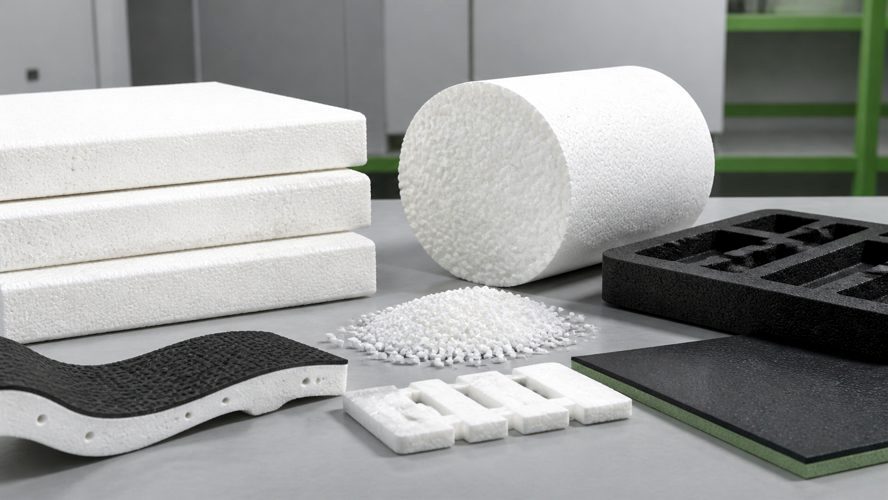
Candidate does not mean qualified. A midsole, helmet pad, automotive spacer and semiconductor shipping insert expose foam to different loads, temperatures, chemicals and regulations. The correct way to evaluate an ETPU foam sheet is to connect polymer grade, cellular structure, forming route and application-specific testing—not to copy a list of end uses from a brochure.
What is ETPU foam?TPU is a thermoplastic block copolymer containing hard and soft segments. The hard domains behave as reversible physical junctions; the soft segments provide flexibility. Resin chemistry, hard-segment content and whether the soft segment is polyether- or polyester-based all influence foamability, recovery, moisture resistance and long-term aging.
ETPU is TPU that has been expanded into a cellular structure. In a common physical-foaming route, CO2, N2 or a controlled gas mixture is dissolved into TPU under elevated pressure. A rapid change in pressure or temperature reduces gas solubility, causing cells to nucleate and grow. Cooling and reorganization of the TPU hard segments then help stabilize the expanded bead.
ETPU is commonly a predominantly closed-cell bead foam. The foam bead is not yet a finished product. Beads must be fused, compressed, cut or otherwise formed into a sheet or three-dimensional component, and the quality of those interfaces often determines the strength of the final part.
How supercritical TPU becomes a large ETPU foam sheet or billetThere are several manufacturing routes. The following sequence is particularly relevant to footwear and other premium parts that require fewer visible bead marks.
!Engineering schematic of Huadong's two-stage ETPU billet and secondary compression-molding route
Figure 1. Engineering schematic of the two-stage route discussed in this article. It is not to scale and is not a factory photograph; actual gas, temperature, pressure and dwell conditions depend on the TPU grade and part specification.
1. Select and condition the TPU resin
The process starts with a TPU grade whose softening, crystallization, gas affinity and melt strength fit the target expansion. Huadong's normal supercritical-foam development baseline uses traceable virgin base resin with a controlled additive package unless a separately validated recycled-content formulation is approved.
Drying matters. Moisture can change processing behavior and, in hydrolysis-sensitive grades, contribute to molecular degradation. Mixing unidentified regrind or different TPU grades can shift viscosity, expansion and shrinkage before the defect becomes visible in the finished part.
2. Saturate and expand the TPU with a physical blowing gas
CO2 usually offers relatively high solubility and strong plasticization. N2 may provide different nucleation and diffusion behavior. Neither gas is universally superior. Research shows that gas choice, pressure, temperature and release history change cell size, cell density and dimensional stability.
The objective is not simply the largest expansion ratio. A very low-density bead can be commercially useless if its cell walls collapse, the bead shrinks excessively or it cannot survive the next molding cycle.
!SEM micrographs showing ETPU cell morphology at different foaming pressures and temperatures
Figure 2. Real SEM micrographs of ETPU prepared at the pressure and temperature conditions printed on the original figure. The scale bars are retained. Source: Zhang et al. (2021), [DOI 10.3390/polym13040656](https://doi.org/10.3390/polym13040656), Figure 2, [CC BY 4.0](https://creativecommons.org/licenses/by/4.0/). This is research evidence—not an AI-generated micrograph and not a Huadong product specification.
3. Stabilize and grade the expanded beads
Fresh ETPU beads continue exchanging gas with the surrounding air. A controlled conditioning period allows dimensions and internal pressure to stabilize. Beads are then screened for size, density and visible defects so the next forming step receives a consistent feedstock.
4. Steam-fuse beads into a molded sheet or large billet
Steam-chest molding rapidly heats the bead surfaces. Near the TPU softening window, polymer-chain mobility increases and adjacent beads are pressed into intimate contact. Soft segments diffuse across the interface; new ordered structures form during cooling and lock the joint together.
This inter-bead welding step is load-bearing. Weakly fused material tends to split along bead boundaries. Strongly fused material is more likely to fail through the foam bead itself—a much better indicator than appearance alone.
Primary research on steam-molded ETPU reported effective inter-bead bonding, a smooth molded surface and strong tensile, elongation and cyclic-recovery behavior for the tested grades. Those results are not universal product specifications, but they confirm the fusion mechanism and the importance of steam pressure, temperature, bead size and cooling.
5. Split, cut or prepare the billet
Large molded ETPU panels can be split, punched or water-jet cut when the grade and density permit. A footwear billet can also be cut into controlled preforms. This creates a bridge between bead-foam economics and the precision of a final matched mold.
6. Secondary compression mold for a more continuous surface
Huadong can compression mold the prepared ETPU preform into the final midsole geometry. The second controlled heat-and-pressure cycle reduces the “pearl” or “rice-grain” surface relief, sharpens sidewalls and logos and can consolidate weak boundary regions.
This is a process advantage, not a free improvement. Too little heat or pressure leaves weak interfaces. Too much can melt the skin, crush cells, increase density and hardness or reduce resilience. Published ETPU sheet research describes this as a narrow processing window: bead surfaces must sinter without destroying the cellular structure.
!Photographs showing the effect of compression-molding temperature on ETPU bead fusion
Figure 3. Published photographs showing the effect of molding temperature at 3.5 MPa for 15 minutes for the tested material: visible loose beads at 140 °C, greater fusion at 145 °C and a more continuous surface at 150 °C. These settings must not be copied as a universal production recipe. Source: Zhang et al. (2021), [DOI 10.3390/polym13040656](https://doi.org/10.3390/polym13040656), Figure 4, [CC BY 4.0](https://creativecommons.org/licenses/by/4.0/).
!SEM micrographs of compression-molded ETPU sheet surfaces and cross-sections
Figure 4. Real SEM images of surface and cross-section evolution under the molding conditions reported in the paper. The original time labels, magnifications and 100 μm scale bars are retained. The images show why surface closure and internal cell preservation must be evaluated together. Source: Zhang et al. (2021), [DOI 10.3390/polym13040656](https://doi.org/10.3390/polym13040656), Figure 6, [CC BY 4.0](https://creativecommons.org/licenses/by/4.0/).
The five properties that make ETPU useful—and what they do not proveElastic recovery
ETPU can recover after repeated compression because the TPU matrix is elastomeric and the cellular structure stores and releases deformation. This supports responsive midsoles, reusable protective pads and anti-fatigue components.
Rebound is method-dependent. A ball-rebound value, pendulum rebound and cyclic-compression energy return are not interchangeable, and none automatically predicts human running economy or protection from injury.
Energy absorption and damping
A foam can return part of the input energy while dissipating another part through cell-wall bending, friction and polymer hysteresis. Applications such as packaging and protective equipment often need controlled energy absorption rather than maximum rebound.
The load curve matters: peak force, plateau stress, densification strain, impact velocity and recovery after repeated impacts should be measured for the actual thickness and density.
Tear, tensile and abrasion resistance
TPU chemistry can provide a useful combination of elongation, toughness and abrasion resistance. In bead foam, however, the finished component has two strength scales: the cell walls inside each bead and the welded boundary between beads.
For a sheet or molded part, report both the test value and fracture path. A clean split along bead interfaces points to a molding problem even when the raw bead specification is acceptable.
Performance across temperature
Selected ETPU grades can remain flexible across a wider temperature range than many conventional cushioning foams. BASF, for example, publishes low-temperature and rebound data for specific Infinergy grades.
That evidence belongs to the named grade and molded density. It should not be converted into a universal temperature claim for every polyether TPU, polyester TPU or supplier formulation.
Thermoplastic processability
Because TPU is thermoplastic, clean production scrap may be mechanically reprocessed under controlled conditions. That creates design options unavailable to permanently crosslinked foams.
“Thermoplastic” does not mean automatically or indefinitely recyclable. Repeated heat and shear can reduce molecular weight and stabilizer content. Adhesives, pigments, fillers, dirt and mixed-material assemblies can prevent high-value recycling. A credible circularity claim needs a defined collection, identification, reprocessing and performance-validation route.
Where ETPU foam sheets can create valueThe table separates material opportunity from product qualification.
Application | Why ETPU may fit | What must be validated before sale |
Footwear midsoles and insoles | Elastic recovery, fatigue resistance, moldable geometry and the option for a refined compression-molded surface | Pair weight, hardness, rebound method, compression fatigue, dimensional aging, flex and outsole/plate bonding |
Sports flooring and anti-fatigue mats | Repeated cushioning, resilience and cuttable sheet formats | Force reduction, vertical deformation, slip resistance, wear, indentation, fire behavior, weathering and the applicable flooring standard |
Helmet, knee and elbow padding | Lightweight cellular cushioning and repeated-impact potential | Peak acceleration/force, impact sequence, temperature conditioning, thickness, fit and the complete protective-equipment standard; foam data alone cannot support an injury-prevention claim |
Reusable protective packaging | Recoverable cushioning, abrasion resistance and custom-cut cavities | Cushion curve, drop sequence, creep under static load, cleanliness, particle shedding, chemical compatibility and electrostatic control for electronics |
Automotive spacers and vibration-isolation parts | Elastic support, damping and potentially useful wide-temperature behavior | Heat aging, compression set, flammability, VOC/fogging, odor, chemical exposure, squeak-and-rattle performance and vehicle-specific durability |
Cycling saddles and ergonomic pads | Local pressure distribution, resilient cushioning and moldable contours | Pressure mapping, fatigue, sweat/cleaner exposure, temperature, cover adhesion and subjective comfort trials |
Low-load wheels or airless-tire concepts | No puncture pressure, elastic deformation and abrasion potential | Rolling resistance, heat build-up, tread wear, fatigue cracking, load rating, speed and failure containment; this is not a general road-tire approval |
Furniture and reusable cushioning | Recovery after compression, low water uptake in suitable closed-cell structures and configurable firmness | Long-term creep, flammability, odor/VOC, body-pressure distribution, cover compatibility and cleaning exposure |
Children's goods and pet products | Soft-touch resilience and resistance to repeated deformation | Applicable toy/consumer-product chemistry, small-parts safety, bite/tear fragments, migration and intended-use testing; ETPU is not automatically “food grade” |
Orthotic or medical-adjacent cushioning | Pressure distribution and customizable geometry may be useful | Named medical-grade resin, biocompatibility, skin-contact duration, sterilization/cleaning, traceability and jurisdiction-specific regulatory review; general ETPU data are insufficient |
Large ETPU sheets versus direct-molded bead partsBoth formats have a place.
Decision factor | Large sheet or billet | Direct steam-molded bead part |
Geometry | Cut, split, laminated or compression molded into multiple formats | Efficient for a dedicated three-dimensional cavity |
Surface | Can be skived, covered or secondary molded for less-visible bead texture | Bead pattern may remain visible or become a deliberate design feature |
Tooling | Flexible for sampling and lower-volume shape changes; final compression molds may still be required | Dedicated steam tooling and filling strategy required |
Interface control | Billet fusion plus optional second consolidation stage | One main opportunity to establish bead fusion |
Density control | Must monitor skin-to-core and sheet-area gradients | Must monitor cavity filling, venting and local packing |
Cost | Extra splitting, cutting or compression step can increase conversion cost | Fewer conversion steps when the direct-molded finish is acceptable |
For premium footwear, Huadong's billet-to-secondary-compression route is useful when a customer wants ETPU recovery and toughness without making visible bead texture the design language. For industrial pads or packaging, a cut ETPU sheet may offer more economical geometry flexibility.
Why virgin resin matters in supercritical ETPUSupercritical foaming amplifies small material variations. Gas solubility, crystallization, viscosity and shrinkage respond to TPU molecular structure and processing history.
A traceable virgin-resin baseline can provide:
• more stable gas uptake and expansion;
• more predictable bead shrinkage and molded density;
• lower risk of incompatible polymer, adhesive or filler contamination;
• cleaner light-color and exposed-surface appearance;
• clearer cause-and-effect during process troubleshooting; and
• resin-lot traceability for repeat orders.
Commercial foam may still contain controlled pigments, nucleating aids or process stabilizers. The defensible wording is virgin base TPU, controlled functional additives and no undeclared recycled or mixed-grade filler—not “nothing except pure TPU.”
An engineered recycled-content TPU can be viable, but it should be treated as a separate formulation with its own rheology, foaming window, aging and mechanical validation.
How to specify an ETPU foam sheetA buyer should not approve a sheet from the material name alone. The RFQ or development specification should include:
1. Intended application, load case, service temperature and required lifetime.
2. TPU family and agreed grade or controlled equivalent.
3. Virgin/recycled-content declaration and permitted additive package.
4. Physical blowing-gas system where disclosure is available.
5. Bead bulk density and finished sheet/part density.
6. Length, width, thickness and tolerances after the defined conditioning period.
7. Density variation across the sheet and from skin to core.
8. Cell structure, open/closed-cell requirement and visible-defect limits.
9. Hardness scale, test location, temperature and conditioning.
10. Rebound or dynamic-compression method—not only a percentage.
11. Tensile, elongation, tear, split strength and fracture-path requirement.
12. Compression set, creep and cyclic-fatigue protocol.
13. Heat, humidity, hydrolysis, UV or chemical aging relevant to the application.
14. Surface texture, bead-mark and color-approval standard.
15. Application-specific requirements such as flame, VOC, ESD, migration or biocompatibility.
16. Resin, foaming, molding and inspection batch traceability.
A practical ETPU development workflow
Gate 1: screen the material
Compare candidate TPU grades at a controlled bead density. Eliminate grades with unstable expansion, excessive shrinkage or inadequate recovery before investing in final tooling.
Gate 2: qualify the sheet or billet
Measure density distribution, cell morphology, fusion, tensile/tear behavior and dimensional aging across more than one position in the large sheet.
Gate 3: qualify the converted part
Secondary compression, cutting, adhesives and coverings can change performance. Test the final geometry and interface system rather than relying on sheet data.
Gate 4: validate the end use
Run the footwear, protective, packaging, automotive or consumer-product standard that matches the intended claim. A material datasheet is supporting evidence, not finished-product approval.
Gate 5: lock production controls
Approve the resin grade, gas/process route, billet density, molding window, aging time, test frequency and traceability record. Define what requires customer reapproval.
How Huadong Soles supports ETPU development
Huadong Soles approaches ETPU as a material-and-process system. Our work can connect virgin-resin control, supercritical bead foam, steam-fused billets, secondary compression molding, ETPU sole development and shoe-mould engineering .
For footwear customers, the objective is not merely to produce a soft foam. It is to hold pair weight, dimensions, surface quality, tear/split resistance, recovery and bonding across production lots.
Send us the application, target density and hardness, part drawing, annual volume, service climate, appearance standard and required tests. Huadong can convert those inputs into a sample plan and a measurable approval specification. Discuss an ETPU project with Huadong .
FAQ: Frequently Asked Questions
What is the difference between TPU and ETPU?
TPU is the solid thermoplastic polyurethane resin. ETPU is TPU that has been physically expanded into a cellular foam, often as beads that are later fused into a sheet or molded part.
How is an ETPU foam sheet manufactured?
One route saturates TPU pellets with supercritical CO2, expands them into ETPU beads and then fuses the beads by steam-chest or compression molding. Large billets can be split or cut, and selected preforms can be compression molded again for final geometry and surface quality.
Why are bead marks visible on some ETPU parts?
The marks are the boundaries and surface relief of the fused foam beads. Their visibility depends on bead size, filling, steam conditions, mold surface and density. A conditioned billet followed by secondary compression molding can reduce the visible texture.
Is ETPU waterproof?
Predominantly closed-cell ETPU can have low water uptake, but “waterproof” is a product-level claim. Cut surfaces, bead interfaces, skin damage, density and assembly seams must be tested for the intended exposure.
Can ETPU be recycled?
Clean TPU is thermoplastic and can be reprocessed, but actual recyclability depends on collection, contamination, adhesives, color, fillers and thermal degradation. Ask for a defined recycling route and property-retention data.
Is ETPU safe for toys, pet products or medical devices?
Not by material name alone. These uses require a suitable grade plus the chemical, migration, mechanical, biocompatibility or regulatory tests applicable to the market and contact scenario.
Is higher rebound always better?
No. Running footwear may value elastic return; packaging or protective pads may need more controlled energy dissipation. Select density and cell structure around the load case.
What is the main failure risk in an ETPU bead-foam part?
Weak inter-bead fusion is a common risk. Inspect whether fracture runs along bead boundaries, then review bead condition, steam temperature/pressure, contact pressure, dwell and cooling.
Technical references
17. Zhang, T. et al. “Compression molding of thermoplastic polyurethane foam sheets with beads expanded by supercritical CO2 foaming.” Polymers (2021). https://doi.org/10.3390/polym13040656
18. Ge, C. et al. “Steam-chest molding of expanded thermoplastic polyurethane bead foams and their mechanical properties.” Chemical Engineering Science (2017). https://doi.org/10.1016/j.ces.2017.09.011
19. Jiang, X. et al. “Evolution of ordered structure of TPU in high-elastic state and their influences on the autoclave foaming of TPU and inter-bead bonding of expanded TPU beads.” Polymer (2021). https://doi.org/10.1016/j.polymer.2021.123872
20. Zhao, J. et al. “Investigation of the effect of foaming process parameters on expanded thermoplastic polyurethane bead foams properties using response surface methodology.” Journal of Applied Polymer Science (2018). https://doi.org/10.1002/app.46327
21. Li, R. et al. “Solubility and diffusivity of CO2 and N2 in TPU and their effects on cell nucleation in batch foaming.” The Journal of Supercritical Fluids (2019). https://doi.org/10.1016/j.supflu.2019.104623
22. Belmonte, A. et al. “Foaming of thermoplastic polyurethane using supercritical CO2 and N2: Antishrinking strategy.” The Journal of Supercritical Fluids (2024). https://doi.org/10.1016/j.supflu.2024.106311
23. BASF. “Infinergy (E-TPU): properties, processing and applications.” Official technical information
---


