
Views: 4 Author: Site Editor Publish Time: 2026-09-02 Origin: Site


The label “supercritical foam” tells you how gas entered the polymer—not whether the finished midsole will be light, durable or fast.
That distinction matters. Two midsoles made from the same polymer can behave very differently when their resin grade, crosslink density, cell size, expansion ratio, geometry or cooling history changes. Conversely, a well-engineered EVA midsole can outperform a poorly matched PEBA or TPU solution for the actual shoe, target price and service conditions.
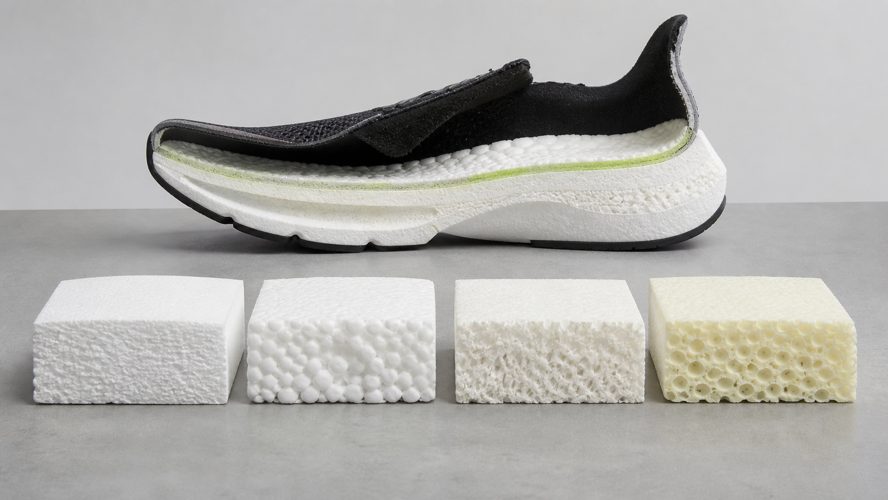
This guide compares the four material families most often discussed in supercritical foam midsoles—EVA, TPU/ETPU, TPEE and PEBA—without turning laboratory results into marketing promises. It explains what each material does well, where production becomes difficult, which process routes are available and what a footwear buyer should test before approving a sole.
The short answer: there is no universal “best” midsole foam
For an initial material shortlist:
• EVA is usually the practical baseline for lightweight cushioning, cost control and broad footwear applications.
• TPU/ETPU is attractive when toughness, repeatable elastic recovery, low-temperature flexibility and bead-molded design possibilities matter.
• TPEE offers a useful balance of spring-like response, strength and thermal stability, but its foaming window and shrinkage control can be demanding.
• PEBA offers strong lightweight-resilience potential for performance footwear, but raw-material cost, melt strength, process window and complete-shoe durability still need validation.
For Huadong's current customer mix, TPU/ETPU is the main commercial focus for supercritical-foam midsole development. Buyers are typically looking for a balance of elastic recovery, toughness, appearance and production durability rather than the lowest possible material density. That is why the ETPU forming route—and especially the quality of bead fusion—deserves as much attention as the TPU grade itself.
The correct choice is a system decision:
Polymer + formulation + blowing gas + process route + cell morphology + density/hardness + sole geometry + outsole/plate + test condition.
If any one of these variables changes, a simple “EVA vs PEBA” comparison can become misleading.
What is supercritical fluid foaming?
In physical foaming, carbon dioxide or nitrogen is dissolved into a polymer under controlled temperature and pressure. A pressure drop, temperature change or mold-volume change then lowers gas solubility. Cells nucleate and grow inside the polymer before cooling, crystallization or crosslinking stabilizes the structure.
When the gas is above its critical temperature and pressure, it has liquid-like density and gas-like diffusivity. This can help it penetrate a polymer and create a fine cellular structure. In production, however, “supercritical foaming” covers several distinct routes—batch foaming, bead foaming, extrusion and foam injection molding—not one standardized recipe.
Physical blowing can reduce reliance on decomposing chemical blowing agents and their reaction by-products. It does not, by itself, prove that a foam has a lower carbon footprint or is automatically recyclable. Resin production, gas compression, heat, cycle time, water use, scrap rate and the final multi-material shoe all matter.
Supercritical CO2 vs nitrogen: which gas is better?
Neither gas wins in every polymer.
CO2 generally dissolves more readily in TPU and strongly plasticizes the polymer. That can lower processing resistance and support expansion. The same high diffusivity can also contribute to post-foaming shrinkage when CO2 leaves soft cell walls faster than air enters them.
Nitrogen normally has lower solubility but slower diffusion. Under suitable conditions, it can promote dense nucleation and improve dimensional retention. In a primary TPU study, CO2 solubility was about one order of magnitude higher than N2, yet N2 produced higher cell density under the tested conditions. More recent TPU and TPEE studies show that controlled CO2/N2 mixtures can reduce shrinkage for particular formulations.
The correct question is therefore not “CO2 or N2?” but:
• How much gas does this resin grade absorb?
• How quickly does the gas leave after expansion?
• Can the polymer melt or crosslinked network hold the growing cells?
• What cooling and post-aging schedule stabilizes the part?
• Does the selected gas route fit the required density, surface and cycle time?
EVA vs TPU vs TPEE vs PEBA: technical comparison
The table below is a development guide, not a universal performance ranking. Actual values must be measured on the proposed formulation and sole geometry.
Material | Why footwear developers choose it | Main processing challenge | Typical decision concern | Best-fit starting point |
EVA | Mature supply chain, low density potential, soft cushioning, broad hardness and cost range | The matrix needs enough strength or crosslink density to hold cells without becoming too rigid or brittle | Compression set, heat shrinkage, fatigue and batch consistency | Lifestyle, walking, casual, sandals, cost-sensitive athletic and large-volume programs |
TPU / ETPU | Toughness, elasticity, cold-flex behavior, cyclic recovery and bead-molded design freedom | CO2-related shrinkage; bead fusion and surface quality add another control layer | Density/cost, dimensional aging, hydrolysis by grade, bead-to-bead bonding | Running, walking, work, outdoor and cushioning systems requiring durable elastic response |
TPEE | Spring-like response, strength and relatively good heat/chemical resistance | Linear grades may lack melt strength; cell coalescence, collapse and shrinkage can narrow the window | Tear/fatigue at target density, processing additives and recovery after heat | Performance components, stabilizing zones and applications balancing response with structural support |
PEBA | Low solid density, low-temperature flexibility and strong resilience potential | Weak melt strength and a narrow grade-specific processing window; cost is high | Complete-shoe durability, bonding, price and whether the geometry uses the material effectively | Premium running, racing and lightweight performance footwear |
Important terminology: TPU is the polymer; ETPU is a product form
TPU means thermoplastic polyurethane. ETPU means expanded thermoplastic polyurethane, commonly produced as foamed beads that are later fused in a mold. ETPU is therefore not a separate base polymer competing with TPU. Its final performance depends on both the microcells inside each bead and the bonding quality between beads.
Similarly, PEBA is the generic polymer family “polyether block amide.” Pebax® is a brand name used for particular PEBA grades, not a synonym that should be applied to every PEBA material.
1. Supercritical EVA foam: the versatile commercial baseline
EVA remains widely used because its vinyl-acetate content, formulation, crosslinking and density can be adjusted across a broad range. It is often the most rational starting point when a brand needs lightweight cushioning and commercial scalability without the price of PEBA.
Its apparent simplicity is deceptive. During gas expansion, the polymer network must be strong enough to prevent cell rupture but mobile enough to allow growth. Research on scCO2-foamed EVA shows that saturation pressure, temperature and decompression rate change cell morphology. Ion-crosslinking studies also show an optimum rather than a “more is better” relationship: a suitable network can reduce cell size, increase cell density and improve compression behavior, while excessive restriction can limit expansion or make the structure brittle.
For buyers, the practical risks are not captured by a single “rebound” number. A direct shoe-sole study of supercritical-N2-foamed EVA/PU blends found that adding PU improved hardness, resilience, friction and abrasion in that formulation, but worsened compression set, tensile strength and tear strength. This is a useful warning: improving one headline property can create a failure elsewhere.
Ask for: density, hardness, rebound method, compression set, heat shrinkage, tensile/tear strength and accelerated cyclic-compression results on the proposed production formulation—not on a generic lab sheet.
2. TPU and ETPU foam: toughness plus a second level of process control
TPU combines hard and soft segments. Changing their ratio affects crystallization, melt strength, expansion and shrinkage. A higher hard-segment content can strengthen the cellular skeleton and reduce shrinkage, but it may also limit expansion and change flexibility.
Supercritical-fluid TPU research repeatedly identifies dimensional stability as a central challenge. CO2 can diffuse out quickly after foaming, causing the foam to contract before air replaces it. Cooling history matters: one primary study found that a cooling-foamed TPU route produced higher resilience, strength and modulus than a heating-foamed route under its test conditions. A 2024 study also reported that selected CO2/N2 mixtures prevented the shrinkage seen in its CO2-only TPU samples.
For ETPU, the expanded bead is only an intermediate product. Steam-chest or compression molding must fuse the beads into a reliable part. A midsole can have good bead properties but still fail because of weak inter-bead bonding, uneven heating, poor venting or an unstable post-molding dimension.
Huadong's two-stage ETPU route: steam-fused billet, then compression molded
Many ETPU midsoles are molded directly from loose expanded beads. The resulting bead structure can perform well, but visible bead boundaries may remain on the surface. For customers who want a more refined appearance and stronger control of the bead interfaces, Huadong can use a two-stage route:
1. Prepare virgin TPU for physical foaming. The selected TPU grade is dried and conditioned because moisture, molecular structure and melt strength affect gas uptake, expansion and shrinkage.
2. Produce ETPU beads with supercritical fluid. CO2, N2 or a controlled gas system is dissolved into the TPU under pressure. Controlled expansion creates microcellular TPU beads at the target density.
3. Stabilize and grade the beads. The expanded beads are conditioned and screened before molding so that size, expansion and residual shrinkage remain within the production window.
4. Steam-fuse the beads into a large ETPU billet. This stage is sometimes called “steam foaming,” but the more precise term is steam-chest fusion or steam-chest molding. Steam rapidly heats the bead skins, increases chain mobility and allows adjacent bead surfaces to interdiffuse while pressure holds them in contact.
5. Condition and prepare the billet. The large foam block is cooled and aged, then cut or prepared as a controlled preform for the final sole mold.
6. Compression mold the preform into the final midsole. Heat, matched-die pressure and mold-surface texture consolidate the preform, define the final geometry and produce a more continuous outer surface.
7. Age, trim and test the molded part. Final density, dimensions, hardness, rebound, split/tear behavior and bonding performance are checked after the specified conditioning time.
Why the second molding stage can look more premium
Direct bead molding often leaves a recognizable “pearl” or “rice-grain” pattern. In the billet-to-compression route, the second heat-and-pressure cycle presses down the surface relief, increases contact between adjacent foam regions and transfers the finish of the matched metal mold. The result can show:
• less visible bead patterning;
• a smoother, more continuous skin;
• sharper logo, edge and sidewall definition;
• more consistent left/right appearance; and
• a surface that is easier to position as a premium midsole rather than a visibly molded bead part.
The result is not automatically mirror-smooth: it still depends on bead size, billet density, preform cutting, mold texture, temperature, pressure and release conditions.
Why part-level tear and split resistance can improve
The weakest path in a poorly molded bead foam is often the boundary between beads. Steam heating softens the bead surface; contact pressure increases the bonded area; molecular chains then diffuse across the interface and form new ordered structures during cooling. A second controlled compression stage can further consolidate weak boundary regions.
This can increase part-level tear and split resistance when failure would otherwise propagate along visible bead interfaces. The strongest evidence of good fusion is not merely a higher test number: during a fracture examination, the crack should pass through the foam beads rather than cleanly separating bead from bead.

Primary steam-chest-molding research supports this mechanism. In one ETPU study, effective inter-bead bonding produced a smooth molded surface and strong tensile, elongation and cyclic-recovery behavior. Separate compression-molding research confirms that ETPU bead surfaces can be sintered into foam sheets, while also warning that the acceptable temperature-and-pressure window is narrow.
The careful wording is important: secondary compression molding does not change TPU into an intrinsically stronger polymer. It can improve the molded component's interface integrity and apparent tear resistance relative to a part with weaker bead fusion. Excess heat or pressure can crush cells, raise density or hardness and reduce resilience; insufficient heat or pressure leaves weak seams.
What buyers should validate for this ETPU process
Compare the two-stage part with a direct bead-molded control at matched size and target weight. The approval report should include:
• surface photographs under controlled lighting, including sidewalls and radii;
• molded density and skin-to-core density gradient;
• tensile strength and elongation at break;
• trouser-tear or die-C tear using an agreed specimen direction;
• split resistance and the observed fracture path—inter-bead versus intra-bead;
• hardness and rebound after conditioning;
• cyclic-compression recovery and compression set;
• dimensional change after heat aging and normal aging; and
• outsole, carrier or plate bond strength after flex, heat and humidity.
This route is particularly relevant for premium running, walking and lifestyle midsoles where the customer wants ETPU recovery and toughness without making the bead texture the main visual feature.
Ask for: bead expansion ratio, molded-part density, fusion quality, split/tear location, post-molding aging dimensions, repeated-compression recovery, hydrolysis/heat-aging conditions and bonding compatibility with the carrier, plate or outsole.
3. TPEE foam: responsive and strong, but not easy to expand
TPEE—also called thermoplastic polyester elastomer or TPC-ET—uses crystalline polyester hard segments and flexible soft segments. It can provide strength, elastic recovery and useful temperature resistance. Those same crystalline and rheological characteristics strongly control nucleation and cell stabilization.
Neat linear TPEE may not develop enough strain hardening to hold rapidly growing cells. In continuous scCO2 extrusion research, fibrillated PTFE increased melt strength and prevented cell collapse, producing much higher expansion and finer cells than neat TPEE under the reported conditions. Other work shows that CO2/N2 co-blowing can reduce shrinkage in a specific TPEE system.
Those results demonstrate engineering potential, not a universal finished-midsole specification. Chain extenders, fillers or fibrillating additives can improve foamability while changing tear strength, recovery, processing stability, recyclability and cost.
Ask for: whether the quoted results belong to neat TPEE or a modified blend, cell collapse after aging, tear propagation, dynamic compression at service temperature, additive disclosure and bonding performance.
4. PEBA foam: high performance potential without automatic superiority
PEBA is attractive because its block structure can combine low density, low-temperature flexibility and elastic recovery. It is a strong candidate for performance midsoles where weight and response justify a higher material and processing cost.
Primary research confirms the potential, but also shows why grade and route matter. A high-pressure mold-opening injection study produced PEBA foam as low as 0.17 g/cm³ and reported resilience up to 82% and compression set below 5% for its best tested formulation. These are study-specific results—not specifications for every PEBA sole.
PEBA grades with more hard segment can offer higher crystallinity, melt strength and compressive strength, while narrowing the foaming window or reducing resilience. Chain extension and controlled crystallization are often used to improve foamability because weak melt strength can allow cells to merge or collapse.
Complete-shoe evidence adds another caution. In a controlled study of new and 450 km worn plated running shoes, running economy worsened in the worn PEBA shoe condition but not significantly in the EVA condition. Because the shoes were different models, the result cannot isolate polymer durability. It does prove that material reputation is not a substitute for aging the complete shoe.
Ask for: matched-density comparison, dynamic stiffness at relevant frequency and temperature, compression fatigue, bonding/primer system, aging data and a complete-shoe test—not just a material datasheet.
What leading footwear brands reveal about midsole material selection
Major brands do not all converge on one “best foam.” Their choices show a more useful pattern: select the polymer and foaming route around the job of the shoe, then tune geometry and supporting components around it.
Brand technology | Publicly identified material/process | Representative use | What a footwear developer should learn |
Skechers Hyper Burst | Skechers describes Hyper Burst as an EVA foam made with a supercritical foaming process that creates tightly packed cells | Lightweight training and racing shoes including the GO RUN Razor and Speed Elite families | A well-executed supercritical EVA can remain commercially relevant when low weight, cushioning, cost control and scalable molding matter |
adidas Boost | adidas identifies Boost as expanded TPU (ETPU) made by expanding TPU particles into closed cells and fusing the particles | Running, walking, basketball and lifestyle products | Bead foam can deliver a recognizable ride across categories, but bead expansion and final fusion are both part of the quality system |
Saucony PWRRUN+, PWRRUN PB and IncrediRUN | Saucony publicly identifies PWRRUN+ as steam-fused TPU foam, PWRRUN PB as PEBA bead foam, and IncrediRUN as a TPEE blend | Daily mileage, speed training, racing and premium cushioning | One brand may need three polymer platforms: durable TPU for daily work, light PEBA for speed, and TPEE blends for a different response profile |
Brooks DNA GOLD | Brooks describes DNA GOLD as 100% nitrogen-infused PEBA cushioning in the Hyperion Elite 4 PB and Elite 5 | Race-day performance | “Pure PEBA” can be a valuable high-performance story when the complete shoe, plate, geometry and testing support it; the material name alone is not the performance claim |
Nike ZoomX | Nike markets ZoomX as its lightest, most responsive foam. A peer-reviewed mechanical study of the Vaporfly prototype identifies the ZoomX midsole as PEBA foam combined with a curved carbon-fiber plate | Racing, speed training and selected premium daily trainers | The celebrated result belongs to a shoe system—PEBA foam, plate, stack geometry and low shoe mass—not to PEBA in isolation |
These examples should not be read as formulas available for copying. Brand foam names usually represent proprietary resin grades, additives, cell structures and processing windows. The practical lesson is to translate the product brief into measurable requirements before selecting the material.
Why this matters for a new footwear program
• Choose supercritical EVA when the development priority is scalable lightweight cushioning with a controlled commercial target.
• Choose ETPU when resilient bead architecture, toughness and broad everyday use justify its weight and molding requirements.
• Investigate TPEE when the shoe needs a firmer spring-like response or a structurally useful performance zone.
• Choose PEBA when weight and elastic response justify premium resin cost and a narrower processing window.
• Consider a hybrid construction when one material cannot deliver cushioning, stability, outsole durability and target cost by itself.
Virgin-resin supercritical foam: what “pure material” should mean
Huadong's standard approach for supercritical foam development is virgin-resin-based processing. In practical sourcing language, this means the base polymer is supplied as controlled, traceable virgin resin rather than an undefined mixture of regrind, reclaimed foam powder or mixed-grade recycled feedstock.
“Pure material” should not be interpreted as “the part contains nothing except one polymer.” Stable commercial foaming may still require a tightly controlled package of pigments, nucleating aids, crosslinking or chain-control agents, processing stabilizers and other functional ingredients. The credible claim is therefore:
Virgin base resin, controlled functional additives and no undeclared recycled or mixed-grade filler.
The production benefits of a virgin-resin baseline
More predictable rheology and melt strength
Cell growth depends on the polymer having enough melt or network strength to hold the expanding gas. Uncontrolled thermal history, chain scission or mixed molecular weights can change viscosity and make cells merge, rupture or collapse. A specified virgin grade gives the process team a more stable starting window for gas saturation, pressure release and cooling.
More consistent cell size, density and shrinkage
Gas solubility, crystallization and diffusion respond to polymer grade and molecular structure. When the incoming resin is consistent, changes in foam density or cell morphology are easier to trace to the process instead of an unknown feedstock variation. That improves the chance of holding pair weight, hardness and dimensions across production batches.
Lower contamination and moisture risk
Mixed regrind can introduce incompatible polymers, degraded fragments, dirt, residual adhesive, fillers or uncontrolled moisture. Depending on the material, these can create irregular nucleation, weak cell walls, odor, discoloration, surface defects or bonding variation. Virgin resin does not eliminate processing risk, but it removes a major source of uncertainty.
Cleaner color and appearance control
White, translucent and bright-color midsoles expose contamination quickly. A controlled virgin-resin base generally makes color matching, speck control and surface consistency easier—especially when a brand requires tight approval limits across repeat orders.
Clearer material traceability
A known resin producer, grade, batch and certificate of analysis create a defensible chain of evidence. If a foam lot moves outside the agreed density, hardness or aging window, the team can investigate raw material and process records rather than working backward from an unknown blend.
What virgin resin does not guarantee
Virgin resin is a consistency strategy, not proof that every property will be superior. A deliberately engineered recycled formulation can perform well when its source, cleaning, molecular condition and additives are controlled. Research has even shown that activated EVA sole waste can be incorporated into scCO2-foamed TPU with residual strain close to the study's neat-TPU control. Achieving that result required material activation, controlled dispersion and validation—it was not a simple substitution of unidentified scrap.
Virgin resin also does not automatically mean lower environmental impact. If sustainability is part of the brief, compare measurable factors such as reject rate, service life, renewable or recycled content, process energy, material separability and verified life-cycle data.
How Huadong should document a pure-material claim
For a buyer who specifies virgin material, the production file should identify:
8. Base-polymer manufacturer and commercial grade.
9. Virgin/recycled-content declaration for the agreed formulation.
10. Lot number and certificate of analysis where available.
11. Approved pigment, nucleating and processing-additive package.
12. Incoming moisture, melt-flow/rheology or other grade-specific checks.
13. Molded density, pair weight, hardness and dimensional-aging records.
14. A rule prohibiting unapproved regrind or cross-grade mixing.
This turns “pure material” from a slogan into a specification that a brand can audit.
How the main supercritical foaming routes differ
Process route | What it is good at | What can go wrong | Suitable development use |
Batch/autoclave foaming | Precise laboratory control of gas saturation, temperature and pressure release; useful for sheets, preforms and beads | Long saturation cycle, non-uniform gas diffusion in thick parts, shrinkage and scale-up limits | Material screening, formulation development, sheets and bead production |
Direct bead foaming + steam-chest molding | Complex shapes, tuneable bead density and resilient structures | Visible bead texture, weak fusion, uneven heating, moisture/drying and dimensional aging | ETPU midsoles where bead appearance is acceptable or intentional |
Steam-fused billet + secondary compression molding | Smoother surface, sharper molded definition and a second opportunity to consolidate bead interfaces | Extra cycle and tooling; excessive heat/pressure can raise density, crush cells or reduce resilience | Premium ETPU midsoles requiring reduced bead marks and stronger part-level split/tear performance |
Continuous extrusion foaming | Continuous sheet/profile output and potentially efficient throughput | Gas mixing, die pressure, melt strength, surface and cooling must remain stable | Sheet stock, profiles and components later cut or molded |
Foam injection molding / core-back | Direct production of complex 3D parts with scalable cycle potential | Shear can damage cells; fixed cavities restrict expansion; tooling and mold-opening control are demanding | Integrated midsoles or components with controlled skin/core structure |
Crosslinked compression foaming | Mature EVA part production and broad density/hardness tuning | Crosslink distribution, shrinkage, trimming and dimensional repeatability | High-volume molded EVA soles and midsoles |
The properties that should decide your material—not the trend
1. Density at the required geometry
Low plaque density does not guarantee a lighter shoe. The material may need thicker walls, a denser skin, extra stabilizers or more outsole coverage. Compare mass on the same size and geometry.
2. Dynamic stiffness, not only Shore hardness
Shore hardness is useful for production control, but it does not describe how the midsole behaves at running impact speed. Dynamic stiffness changes with frequency, temperature, strain amplitude and aging.
3. Compression set and fatigue
Compression set measures residual deformation after a specified load, time, temperature and recovery period. Fatigue testing tracks progressive changes over many cycles. Report the exact method; otherwise, two “compression set” values may not be comparable.
4. Resilience versus energy return
Ball rebound, material resilience and shoe-level energy return are related but not interchangeable. The complete shoe includes geometry, outsole rubber, strobel, adhesives, insole and sometimes a plate. A high material rebound value does not prove better running economy.
5. Tear, abrasion and bonding
Midsole foams can fail by cell-wall tearing, flex cracking, interface separation or abrasion at exposed zones. Test the proposed color, density, primer and adhesive system. When dense rubber protects the contact surface, evaluate the rubber-midsole interface after flexing, heat and moisture.
6. Dimensional stability after molding
Record length, width, thickness and warpage after demolding and after a defined conditioning period. This is especially important for highly expanded TPU/TPEE systems and tight assembly tolerances.
7. Temperature and aging
Test the climate the shoe will actually face. Low-temperature flexibility, hot-car shrinkage, humidity/hydrolysis, UV/color change and thermal cycling can alter rankings that look simple at room temperature.
A practical footwear material-selection matrix
Use this as a starting hypothesis, then validate samples.
Product brief | First material route to investigate | Why | Validation priority |
High-volume casual/walking shoe with strict target cost | Crosslinked EVA or EVA-based blend | Mature, lightweight, tuneable and commercially scalable | Compression fatigue, shrinkage, outsole bonding |
Daily trainer needing durable elastic cushioning | ETPU or engineered EVA/TPU system | Balances recovery, toughness and production flexibility | Molded-part density, fusion, fatigue, weight |
Premium lightweight racing shoe | PEBA, then compare with advanced EVA/TPU at matched geometry | Strong weight-resilience potential | Complete-shoe running/aging test, bonding, cost |
Outdoor/work footwear exposed to cold and repeated flex | Suitable TPU/ETPU grade or hybrid construction | Toughness and cold-flex potential | Hydrolysis, flex fatigue, outsole adhesion, temperature range |
Responsive structural insert or localized cushioning zone | Modified TPEE or PEBA | Strength-response balance and component-level tuning | Tear, interface design, shrinkage, dynamic stiffness |
Cost/performance hybrid | Dual-density or multi-material sole | Places premium foam only where it creates value | Interface durability, molding tolerance, repair/recycling pathway |
What to put in a supercritical foam midsole specification
A supplier comparison becomes useful only when every candidate receives the same test brief. Include:
15. Target shoe type, user weight range and service climate.
16. Finished sole size, geometry, pair-weight target and tolerance.
17. Polymer family, commercial grade or agreed equivalent, color and additives.
18. Foaming route and gas system where disclosure is possible.
19. Molded-part density and density tolerance—not only raw-bead density.
20. Hardness test scale, location, conditioning time and temperature.
21. Rebound/resilience method with specimen geometry and conditioning.
22. Compression set and cyclic-fatigue method, load, cycles and recovery time.
23. Tensile, tear, flex, heat-shrinkage and dimensional-aging requirements.
24. Bond strength before and after heat, humidity and flex conditioning.
25. Cosmetic limits for skin, bead definition, sink, flash, color and warpage.
26. Traceability rules for resin, compound, molding batch and inspection record.
For a development program, require a matched comparison: same sole geometry, same size, defined density window, same outsole coverage and the same conditioning/test methods. Without those controls, a material comparison is mostly a comparison of prototypes.
How Huadong Soles approaches material selection
Huadong Soles supports footwear developers across multiple sole material families rather than forcing every brief into one foam. Our public manufacturing portfolio includes EVA soles , ETPU soles , PEBA shoe soles , thermoplastic soles , rubber soles and shoe-mould development . For supercritical foam programs, our normal development baseline is traceable virgin base resin with a controlled functional-additive package, unless the customer approves a separately validated recycled-content formulation.
That multi-material view matters because the best commercial solution may be a hybrid: a responsive foam carrier, a durable rubber contact surface and a geometry designed around the target stiffness and weight. Material selection, mold design, sampling, physical testing and production control need to be evaluated together.
If you are developing a new sole, send Huadong the shoe category, target weight, expected annual volume, target market, performance priorities and reference sample. We can help convert those requirements into a material shortlist and a testable development brief. Discuss your shoe-sole project with Huadong .
FAQ: Frequently Asked Questions
Is a supercritical foam midsole better than a chemically foamed midsole?
Not automatically. Supercritical physical foaming can create fine cells without relying on a decomposing chemical blowing agent, but performance still depends on formulation, density, cell stability, geometry and process control. Compare finished-part properties and life-cycle evidence, not only the blowing method.
Which is better for a running midsole: PEBA or EVA?
PEBA often offers a strong lightweight-resilience opportunity, while EVA usually offers lower cost, mature processing and broad tuneability. The answer changes with grade, density, geometry, outsole and aging. Test complete shoes under the same conditions.
What is the difference between TPU and ETPU?
TPU is the thermoplastic polyurethane polymer. ETPU is expanded TPU, often supplied as foamed beads and fused into a molded part. ETPU performance therefore depends on both the foam inside the beads and the strength of the bead-to-bead fusion.
Is TPEE the same as TPU?
No. TPEE uses polyester hard segments and flexible soft segments; TPU contains urethane linkages and can use different polyester- or polyether-based soft segments. They have different rheology, aging risks, bonding behavior and foaming windows.
Does CO2 make better cells than nitrogen?
It depends on the polymer and process. CO2 usually has higher solubility and stronger plasticization. Nitrogen can support high nucleation density and slower gas loss in some systems. Controlled mixtures may balance expansion and dimensional stability.
Does smaller cell size always mean a better midsole?
No. Fine, uniform cells can improve consistency and strength, but final density, cell-wall thickness, anisotropy, skin structure and bonding can dominate performance. Cell size must be interpreted with mechanical and aging data.
Does high rebound prove better running economy?
No. Rebound is method-dependent, and running economy is a human response to the complete shoe. Midsole geometry, stiffness distribution, outsole, plate, mass and the runner all interact.
What should a buyer request before approving a foam sole?
Request a controlled specification, production-representative samples, exact test methods, dimensional-aging data, compression-fatigue results, bonding validation and batch traceability. Compare candidates at matched geometry and weight whenever possible.
What does “pure material” mean in a supercritical foam midsole?
For procurement, it should mean a declared virgin base-resin grade with controlled functional additives and no undeclared regrind, reclaimed foam powder or mixed-grade filler. It should not be used to imply that a commercial foam contains no pigments, nucleating aids or processing stabilizers.
How can an ETPU midsole be made with fewer visible bead marks?
Huadong can first steam-fuse supercritical-foamed ETPU beads into a conditioned large billet, then prepare a preform and compression mold it in a matched metal mold. The second heat-and-pressure cycle reduces surface bead relief and transfers a more continuous mold finish. Process settings must preserve the internal cells rather than crushing them.
Does secondary compression molding make ETPU harder to tear?
It can improve part-level tear and split resistance when the main weakness is insufficient bead-to-bead fusion. Heat, pressure and contact time promote interfacial chain diffusion and consolidate weak boundaries. The claim should be verified with tear, split and fracture-path testing because excessive molding can damage cells or make the part too dense.
Do leading running-shoe brands all use PEBA foam?
No. Nike and several racing platforms use PEBA-based systems, while adidas Boost uses ETPU, Skechers Hyper Burst uses supercritical-process EVA, and Saucony publicly uses TPU, PEBA and a TPEE blend across different products. The shoe's task determines the material choice.
Primary research used for this guide
27. Jacobs, L. J. M. et al. “Foam processing of poly(ethylene-co-vinyl acetate) rubber using supercritical carbon dioxide.” Polymer (2004). https://doi.org/10.1016/j.polymer.2004.08.061
28. Li, T. et al. “Effect of ion-crosslinking on supercritical CO2 foaming behavior and foam properties of EVA/ZnO composites.” Composites Communications (2021). https://doi.org/10.1016/j.coco.2021.100760
29. Zhang, R. et al. “Physicomechanical, friction, and abrasion properties of EVA/PU blend foams foamed by supercritical nitrogen.” Polymer Engineering & Science (2017). https://doi.org/10.1002/pen.24598
30. Li, R. et al. “Solubility and diffusivity of CO2 and N2 in thermoplastic polyurethanes and their effects on cell nucleation in batch foaming.” The Journal of Supercritical Fluids (2019). https://doi.org/10.1016/j.supflu.2019.104623
31. Zhao, J. et al. “Investigation of the effect of foaming process parameters on expanded thermoplastic polyurethane bead foams properties using response surface methodology.” Journal of Applied Polymer Science (2018). https://doi.org/10.1002/app.46327
32. Wang, G. et al. “Structure-tunable thermoplastic polyurethane foams fabricated by supercritical carbon dioxide foaming and their compressive mechanical properties.” The Journal of Supercritical Fluids (2019). https://doi.org/10.1016/j.supflu.2019.04.004
33. Belmonte, A. et al. “Foaming of thermoplastic polyurethane using supercritical CO2 and N2: Antishrinking strategy.” The Journal of Supercritical Fluids (2024). https://doi.org/10.1016/j.supflu.2024.106311
34. Jiang, J. et al. “Improving the continuous microcellular extrusion foaming ability with supercritical CO2 of thermoplastic polyether ester elastomer through in-situ fibrillation of polytetrafluoroethylene.” Polymers (2019). https://doi.org/10.3390/polym11121983
35. Xu, J. et al. “Anti-shrinkage, high-elastic, and strong thermoplastic polyester elastomer foams fabricated by microcellular foaming with CO2 & N2 as blowing agents.” Journal of CO2 Utilization (2022). https://doi.org/10.1016/j.jcou.2022.102076
36. Wang, G. et al. “Lightweight, super-elastic, and thermal-sound insulation bio-based PEBA foams fabricated by high-pressure foam injection molding with mold-opening.” European Polymer Journal (2018). https://doi.org/10.1016/j.eurpolymj.2018.04.002
37. Li, Y. et al. “Study of the microstructure, foaming property and cyclic compression performance of poly(ether-block-amide) foams fabricated by supercritical CO2 foaming.” The Journal of Supercritical Fluids (2023). https://doi.org/10.1016/j.supflu.2023.106052
38. Rodrigo-Carranza, V. et al. “Influence of different midsole foam in advanced footwear technology use on running economy and biomechanics in trained runners.” Scandinavian Journal of Medicine & Science in Sports (2023). https://doi.org/10.1111/sms.14526
39. Hoogkamer, W. et al. “A comparison of the energetic cost of running in marathon racing shoes.” Sports Medicine (2018). https://doi.org/10.1007/s40279-017-0811-2
40. Li, L. et al. “Fabrication of sustainable composite foam from ethylene vinyl acetate-based sole waste via solid-state shear milling and supercritical carbon dioxide foaming technologies.” ACS Sustainable Chemistry & Engineering (2023). https://doi.org/10.1021/acssuschemeng.3c02390
41. Ge, C. et al. “Steam-chest molding of expanded thermoplastic polyurethane bead foams and their mechanical properties.” Chemical Engineering Science (2017). https://doi.org/10.1016/j.ces.2017.09.011
42. Jiang, X. et al. “Evolution of ordered structure of TPU in high-elastic state and their influences on the autoclave foaming of TPU and inter-bead bonding of expanded TPU beads.” Polymer (2021). https://doi.org/10.1016/j.polymer.2021.123872
43. Zhang, T. and Lee, S. “Compression molding of thermoplastic polyurethane foam sheets with beads expanded by supercritical CO2 foaming.” Polymers (2021). https://doi.org/10.3390/polym13040656
Brand-source notes
• Skechers: GO RUN Speed Elite Hyper / Hyper Burst supercritical-process EVA
• adidas: Boost is expanded thermoplastic polyurethane
• Saucony: PWRRUN PB PEBA, PWRRUN+ TPU and IncrediRUN TPEE blend
• Brooks: DNA GOLD nitrogen-infused PEBA
• Nike: current ZoomX positioning ; polymer identification is supported by the Hoogkamer paper above
---


