
Views: 21 Author: Site Editor Publish Time: 2026-08-07 Origin: Site


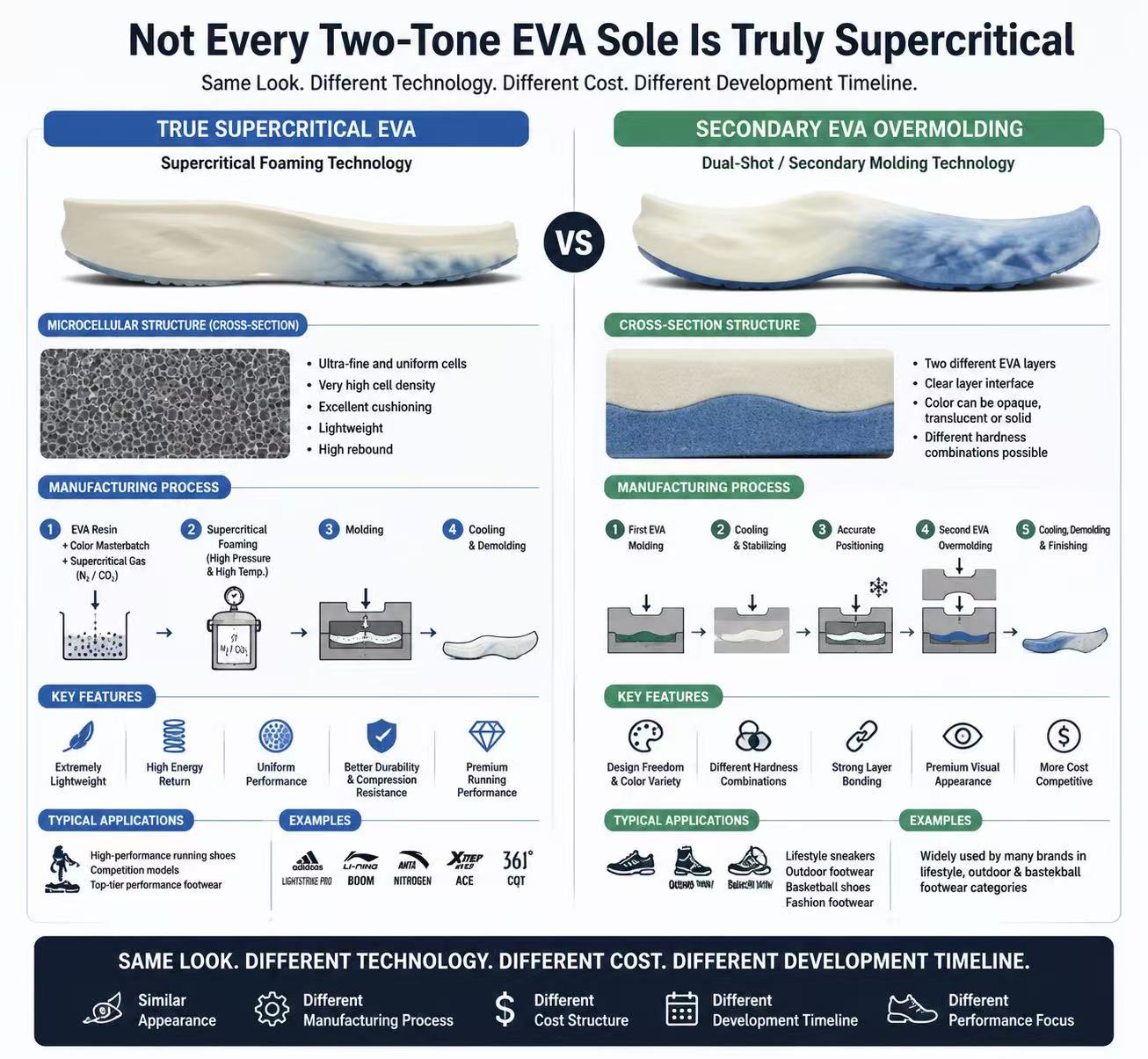
Walk into any sneaker store today, and you'll find more and more shoes featuring beautiful two-tone EVA midsoles.
Cloud-like color transitions.
Semi-transparent effects.
Premium-looking cushioning.
Many people simply call them "Supercritical EVA."
But here's the reality:
Not every two-tone EVA midsole is truly made with supercritical foaming technology.
In fact, many midsoles that look almost identical are manufactured using completely different processes.
Understanding these differences helps footwear brands make better decisions—not only about performance, but also about development cost, tooling, and production timelines.
True supercritical EVA is one of today's most advanced lightweight cushioning technologies.
Instead of using traditional chemical foaming agents, manufacturers inject gases such as nitrogen (N₂) or carbon dioxide (CO₂) under supercritical conditions. During molding, the gas forms an extremely fine and uniform microcellular structure throughout the EVA.
The result is a midsole that offers:
• Extremely low weight
• Excellent energy return
• Uniform cell structure
• Better compression resistance
• Long-lasting cushioning performance
Because of its superior performance, true supercritical foam is commonly used in premium running footwear.
Typical Examples
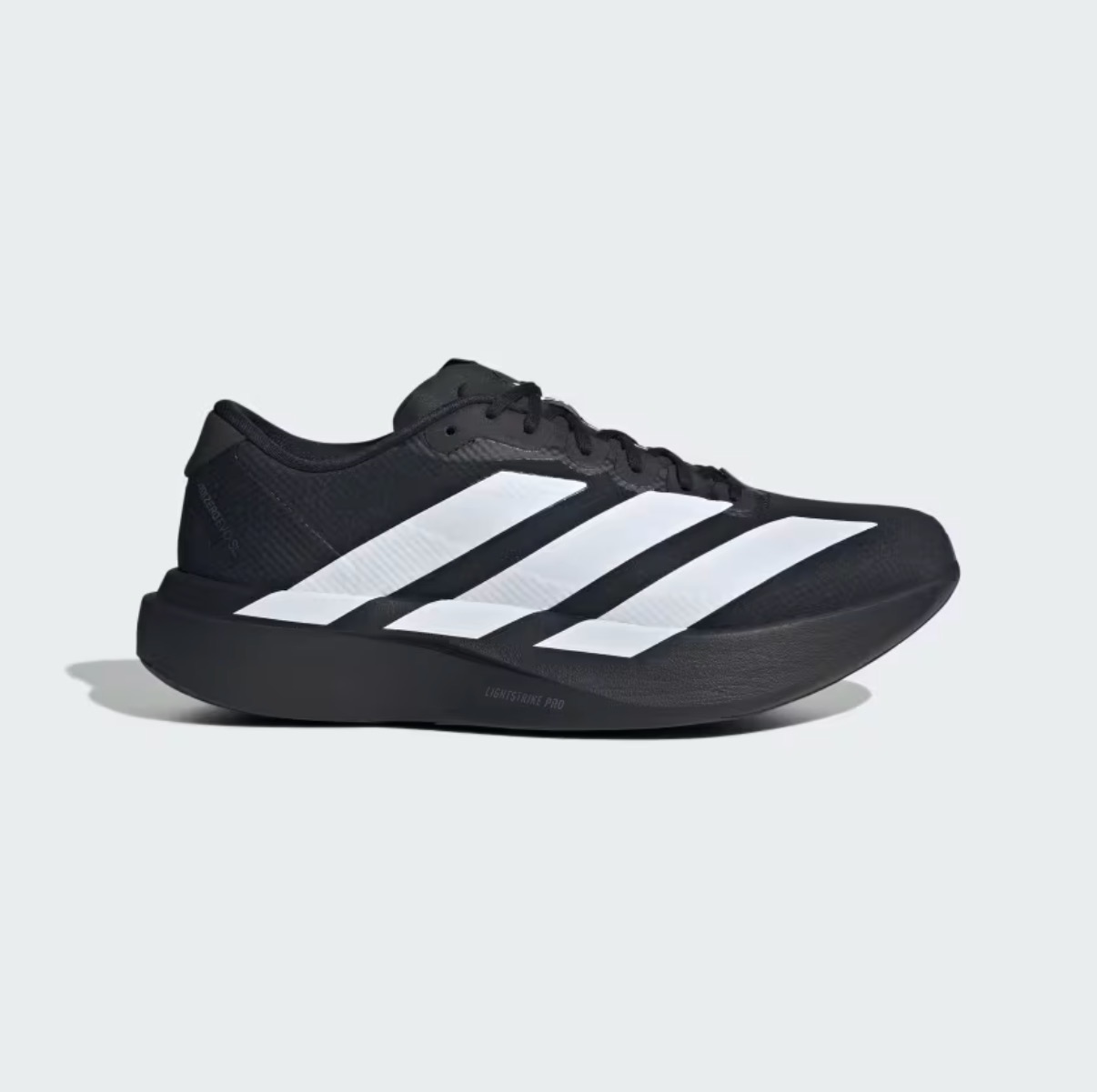
• adidas Lightstrike Pro
• Li-Ning BOOM
• ANTA Nitrogen Technology
• Xtep ACE
• 361° CQT
While every brand has its own formulation, they all rely on genuine supercritical foaming technology rather than conventional EVA processing.
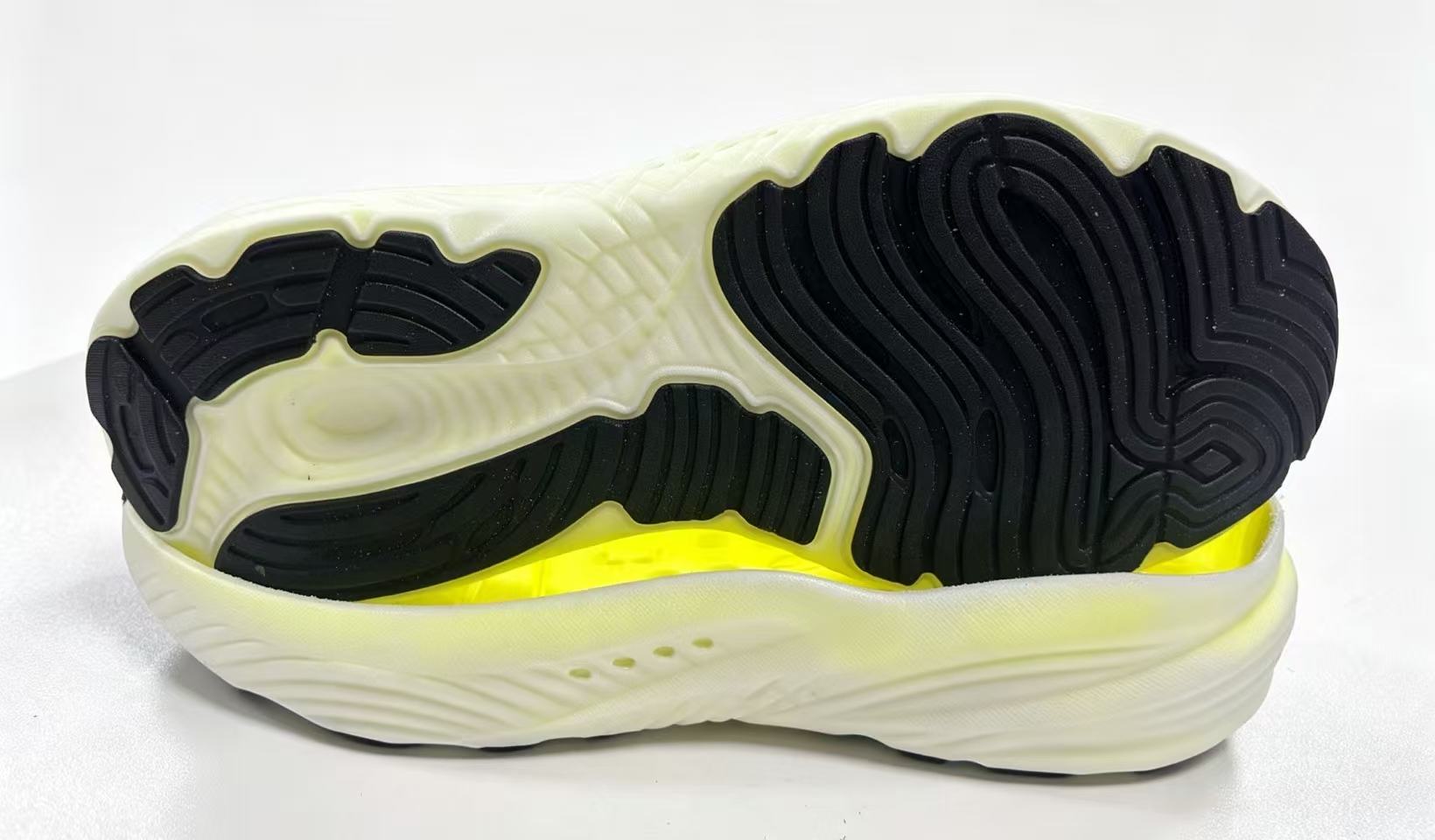
Many midsoles are designed to look like supercritical foam, even though the material itself is produced using conventional EVA technology.
In the footwear industry, these products are often referred to as "Supercritical-Look EVA."
The goal isn't necessarily to replicate the material performance.
Instead, it's to recreate the premium visual appearance.
There isn't just one answer.
Different factories may use different solutions depending on the design requirements.
However, one of the most common manufacturing methods is:
Secondary EVA Overmolding
Also known as:
• Dual-Shot EVA
• Secondary EVA Molding
• EVA Overmolding
Instead of mixing two colors inside one piece of EVA, manufacturers first mold one EVA component.
After it cools and stabilizes, it is placed into a second mold where another EVA material—often a translucent or differently colored compound—is molded around or onto the first component.
After finishing and polishing, the final product creates a cloudy, layered visual effect that many people associate with supercritical foam.
Advantages
• Premium two-tone appearance
• Greater design flexibility
• Can combine different hardness levels
• More stable color control than random pigment mixing
Challenges
This process is much more complicated than standard EVA molding.
Development usually involves:
• Two molding stages
• Precise positioning
• Bonding between EVA layers
• Repeated color matching
• Dimensional verification after secondary molding
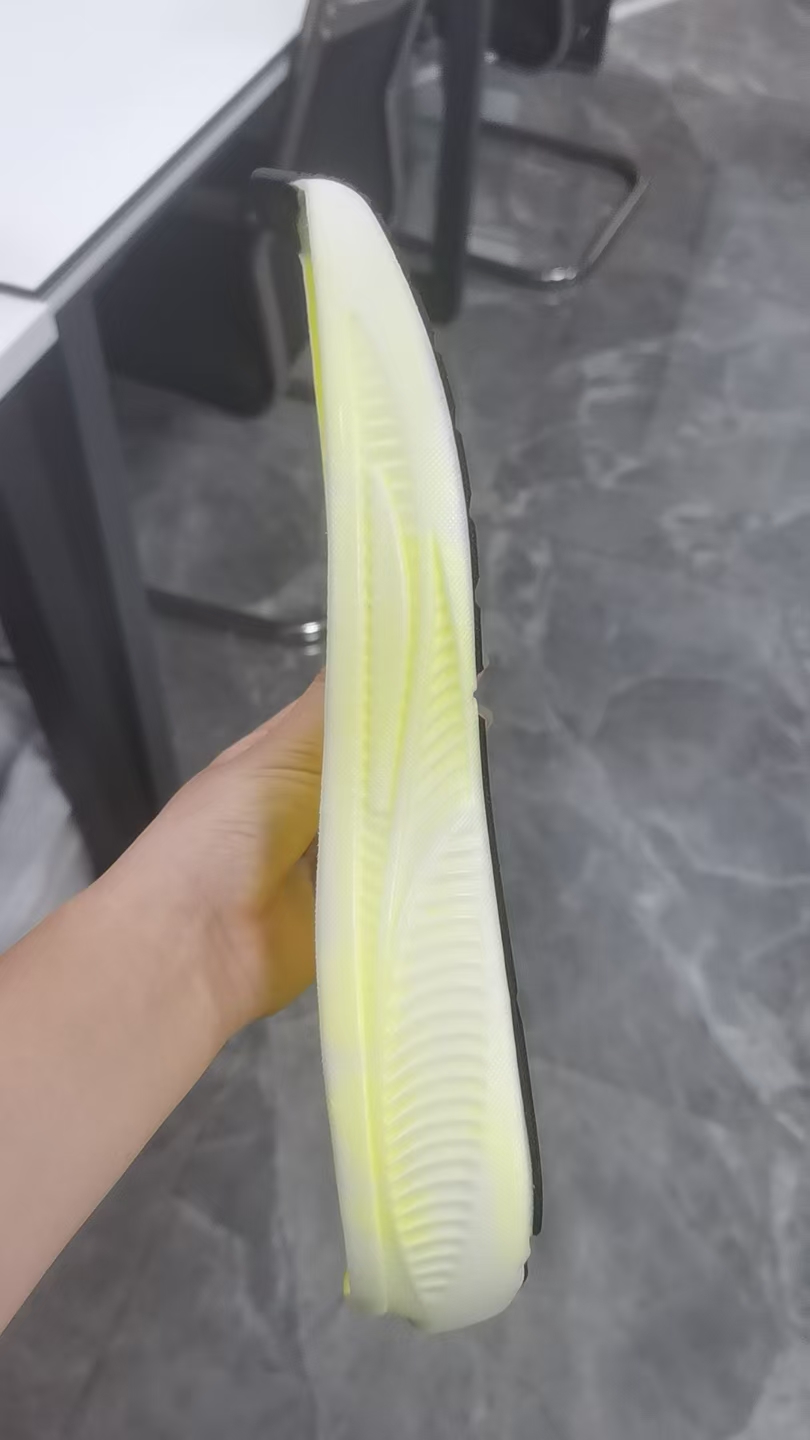
In many projects, color development takes longer than mold manufacturing itself.
Many tech packs simply specify:
Two-Tone EVA Midsole
or
Supercritical EVA Look
Unfortunately, those descriptions don't explain how the product is expected to be manufactured.
For the factory, these are very different requests.
True supercritical foam requires specialized materials and processing equipment.
A supercritical-look midsole created through secondary EVA overmolding requires a completely different development approach, including additional molding steps, color matching, and bonding verification.
Although the finished products may appear similar, their manufacturing methods, development timelines, tooling requirements, and production costs can differ significantly.
The answer is:
Both.
Premium performance running shoes often use true supercritical foam to achieve maximum cushioning and energy return.
Many lifestyle, outdoor, and fashion footwear collections, however, use conventional EVA technologies to create a similar premium appearance while balancing production efficiency and cost.
Even within the same brand, different product lines may use different manufacturing processes depending on their positioning.
Appearance alone is rarely enough.
Technology | Appearance | Performance | Development Complexity | Cost |
True Supercritical EVA | Fine microcellular structure | ★★★★★ | ★★★★★ | High |
Supercritical-Look EVA (Secondary Overmolding) | Cloud-like or layered color effect | ★★★☆☆ | ★★★★☆ | Medium–High |
Although both may look similar on the shelf, the technology behind them is entirely different.
At first glance, many two-tone EVA midsoles look almost identical.
Some feature smooth color transitions. Others have semi-transparent effects or layered color combinations.
It's easy to assume they're all made using the same technology.
But that's rarely the case.
The biggest misunderstanding in today's footwear industry isn't choosing the wrong manufacturing process.
It's assuming that every supercritical-looking midsole is actually made with supercritical technology.
For footwear brands, understanding this distinction is more than a technical detail.
It affects product positioning, tooling strategy, development timelines, manufacturing costs, and ultimately, the success of the final product.
True supercritical EVA delivers outstanding performance for high-end athletic footwear.
Secondary EVA overmolding offers brands another way to achieve a premium visual effect with greater design flexibility.
Neither approach is inherently better.
The right choice depends on what your product is designed to achieve.
Because in footwear development, understanding how a product is made is often just as important as understanding what it looks like.
Q1: What is true supercritical EVA?
A: True supercritical EVA is an advanced lightweight cushioning technology that uses physically injected gases such as nitrogen (N₂) or carbon dioxide (CO₂) under supercritical conditions instead of traditional chemical foaming agents. This creates an extremely fine and uniform microcellular structure, delivering low weight, excellent energy return, and long-lasting cushioning performance.
Q2: What is "supercritical-look" EVA?
A: "Supercritical-look" EVA refers to midsoles that are designed to visually resemble supercritical foam—featuring cloud-like color transitions, semi-transparent effects, or layered aesthetics—but are actually manufactured using conventional EVA technologies, most commonly secondary EVA overmolding (dual-shot molding).
Q3: How is the supercritical-look effect created?
A: The most common method is secondary EVA overmolding. Manufacturers first mold one EVA component, allow it to cool and stabilize, then place it into a second mold where another EVA material—often translucent or differently colored—is molded around or onto the first component. After finishing and polishing, this creates a cloudy, layered visual effect.
Q4: Which process offers better performance—true supercritical or supercritical-look?
A: True supercritical EVA delivers superior performance, including higher energy return, better compression resistance, and longer-lasting cushioning. Supercritical-look EVA (secondary overmolding) focuses primarily on visual aesthetics and design flexibility, offering moderate performance at a more balanced production cost.
Q5: Can I tell the difference just by looking at the midsole?
A: Rarely. Appearance alone is not enough to distinguish the two. Both can look very similar on the shelf. The difference lies in the cellular structure, material composition, and manufacturing process—which require laboratory analysis or detailed knowledge of the production method.
Q6: Why would a brand choose supercritical-look EVA instead of true supercritical?
A: Brands choose supercritical-look EVA when the primary goal is aesthetic appeal rather than maximum performance. Secondary overmolding offers greater design flexibility, more stable color control, and lower production costs compared to true supercritical foaming. It is particularly popular for lifestyle, fashion, and outdoor footwear where visual impact matters as much as cushioning performance.
Q7: How do development timelines differ between the two processes?
A: True supercritical foam requires specialized materials and processing equipment, with development focused on optimizing the foaming parameters. Supercritical-look EVA via secondary overmolding involves two molding stages, precise positioning, layer bonding, and extensive color matching—often making color development take longer than mold manufacturing itself.
Q8: Which major brands use true supercritical EVA?
A: Many premium performance running brands use true supercritical EVA, including:
adidas (Lightstrike Pro)
Li-Ning (BOOM)
ANTA (Nitrogen Technology)
Xtep (ACE)
361° (CQT)
However, these same brands often use conventional EVA overmolding for their lifestyle and fashion collections.
Q9: Does secondary EVA overmolding have any advantages beyond appearance?
A: Yes. Secondary overmolding allows brands to combine different hardness levels within a single midsole—for example, softer cushioning in the heel and firmer support in the forefoot. It also offers greater design freedom for complex geometries and multi-color combinations that are difficult to achieve with single-shot supercritical foaming.
Q10: What are the biggest development challenges with secondary overmolding?
A: Key challenges include:
Precise positioning of the first component in the second mold
Reliable bonding between different EVA layers
Consistent color matching across production batches
Dimensional verification after secondary molding (shrinkage risk)
Extended development timelines for color approval
Q11: Are the material costs significantly different between the two processes?
A: Yes. True supercritical EVA requires specialized raw materials and high-pressure processing equipment, making it more expensive. Secondary overmolding uses conventional EVA compounds but involves additional tooling (two molds instead of one) and longer cycle times. While the material cost for supercritical-look EVA is lower, the overall tooling and development costs can still be substantial.
Q12: How should brands specify their requirement in a tech pack?
A: Brands should avoid simply writing "Two-Tone EVA Midsole" or "Supercritical EVA Look." Instead, specify clearly:
For true supercritical performance: "True supercritical EVA foam with ≥XX% energy return, manufactured via physical foaming (N₂/CO₂)."
For visual effect only: "Two-tone EVA midsole via secondary overmolding / dual-shot EVA process with cloud-effect color transition."
This clarity ensures the factory understands the performance expectations and manufacturing approach.
Q13: Is one process inherently better than the other?
A: Neither is inherently better. The right choice depends on the product's intended purpose:
True supercritical EVA is the best choice for high-performance athletic footwear where cushioning, energy return, and weight reduction are critical.
Secondary overmolding / supercritical-look EVA is ideal for lifestyle, fashion, and casual footwear where premium aesthetics and design flexibility are the primary drivers, with balanced cost considerations.
Q14: What is the biggest misunderstanding in the industry regarding two-tone EVA midsoles?
A: The biggest misunderstanding is assuming that every midsole with a premium, cloudy, or two-tone visual effect is actually manufactured using supercritical foaming technology. In reality, many visually similar products are made using completely different processes with significantly different performance characteristics, development timelines, and cost structures.
Q15: What's the key takeaway for footwear brands and developers?
A: Understanding how a product is made is just as important as understanding what it looks like. Brands should base their material and process decisions on product positioning, performance requirements, development timelines, and budget—not on visual appearance alone. Clear communication between design teams, developers, and factories is essential to avoid costly misunderstandings.


