
Views: 17 Author: Site Editor Publish Time: 2026-04-10 Origin: Site


In modern individual soldier equipment systems, the soles of military footwear and combat boots are far more than ordinary cushioning components; they are the "tactical cornerstone" bearing the weight of a soldier's foot protection, mobility, and battlefield adaptability. From the biting winds of the Arctic ice fields to the scorching sands of deserts and Gobi, from the slippery mud of jungle swamps to the sharp debris of urban ruins, every design element and material choice of the sole directly relates to a soldier's combat safety and sustained combat capability. Unlike civilian footwear soles, which prioritize comfort and aesthetics, military footwear soles focus on "adaptability to extreme environments, all-around protection, and ultra-long durability," undergoing rigorous standardized testing to become the most reliable "battlefield partner" on a soldier's feet. This article will comprehensively introduce the structure, materials, and functional characteristics of military footwear and combat boot soles, and analyze their core testing standards in detail, showcasing the military technological strength behind this "small component."
I. Core Positioning and Design Logic of Military Footwear and Combat Boot Soles The design of military footwear (including training shoes and duty shoes) and combat boot soles always revolves around "real combat needs," focusing on solving three key problems: adaptability to unpredictable and complex terrain, wear resistance and durability for prolonged high-intensity use, and comprehensive foot protection to avoid foot injuries caused by improper sole design—research shows that in field operations, over 60% of foot injuries are related to unreasonable sole design. Compared to civilian footwear soles, their design logic has distinct military characteristics: it does not pursue excessive lightweighting, but achieves the optimal balance between protection, durability, and comfort; it is not limited to single-scenario adaptation, but considers both general applicability to multiple terrains and specific optimization for special scenarios; it does not rely on a single material, but achieves functional complementarity through multi-layered composite structures.
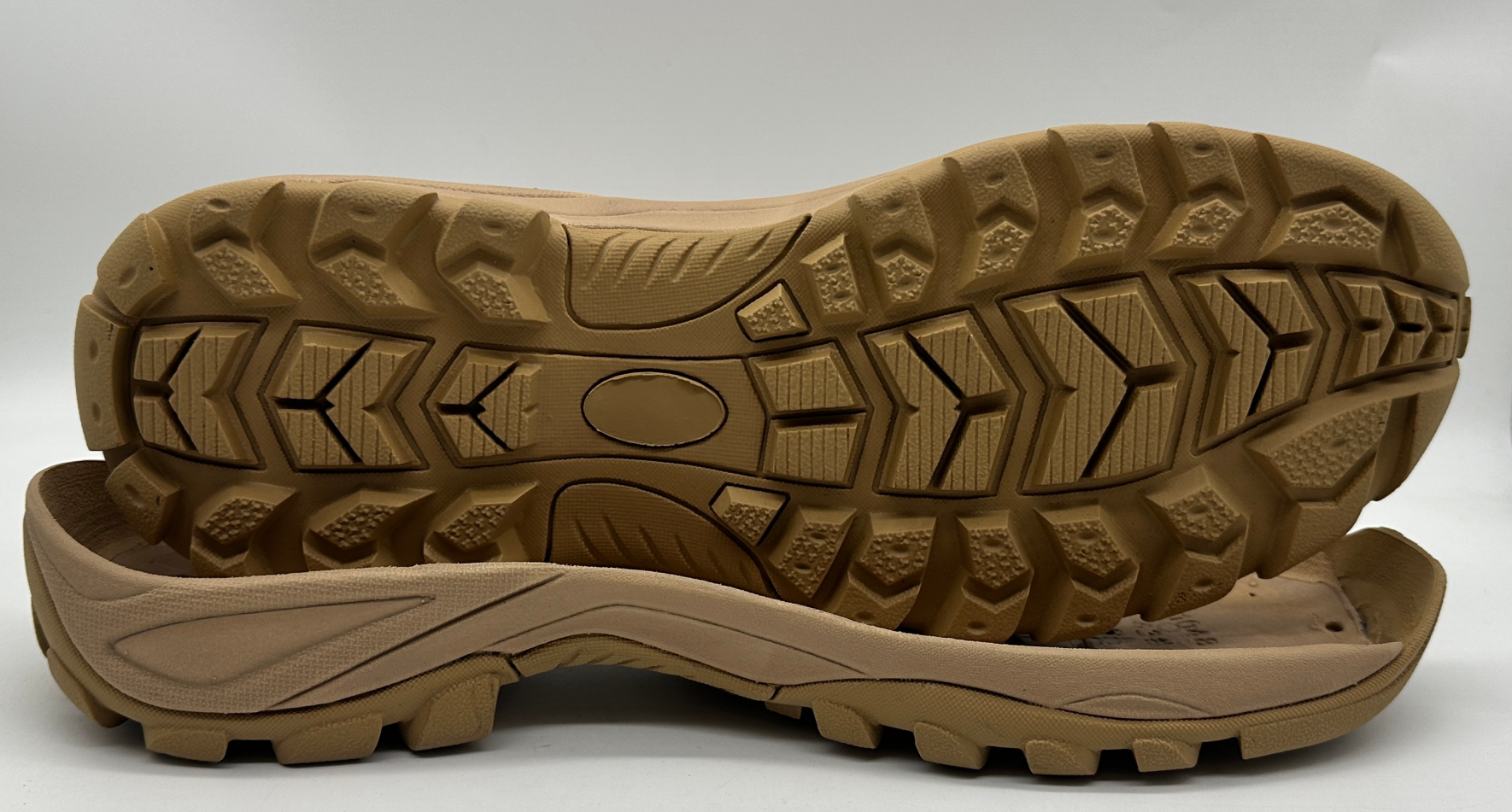
From a usage perspective, military footwear soles are designed for light to moderate scenarios such as daily training and duty, emphasizing lightweight, breathability, and basic protection. Combat boot soles, on the other hand, are designed for high-intensity combat and deployment in extreme environments, strengthening core performance characteristics such as puncture resistance, slip resistance, impact resistance, and high/low temperature resistance. They even need to be adapted to special tactical maneuvers such as parachuting, rappelling, and tank driving, becoming an important component of the individual soldier's protection system. Regardless of the type, the sole design must undergo battlefield verification and standardized testing to ensure stable performance under various extreme conditions.
II. Structural, Material, and Functional Characteristics of Military Footwear and Combat Boot Soles
(I) Core Structure: Multi-layered Composite, Each with its Own Function
Modern military footwear soles generally adopt a "multi-layered composite structure," with each layer performing a different function, working together to achieve all-round protection and adaptability. A typical structure consists of three layers from the outside in, with some special combat boots adding a dedicated protective layer:
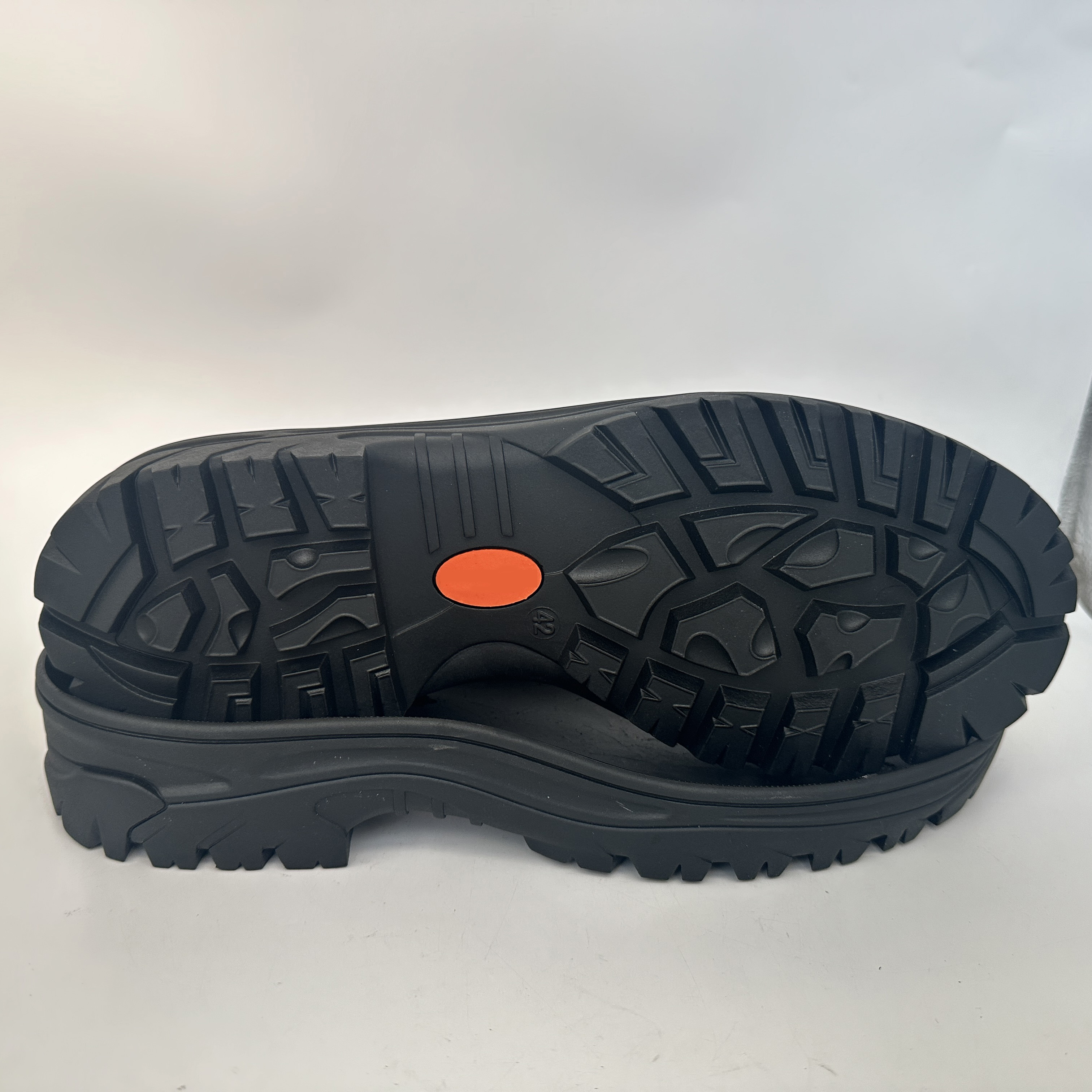
Outsole (Bigfoot): Directly in contact with the ground, it is the "first line of defense" of the sole. Its core functions are wear resistance, slip resistance, puncture resistance, and corrosion resistance. The outsole surface is designed with custom tread patterns to suit different terrain conditions. The material is primarily oil-resistant rubber composites, with heat- and cold-resistant rubbers used in some special scenarios. Some models incorporate inserts to enhance grip, and thicker materials are added to key areas to extend lifespan. For example, jungle combat boots use softer rubber for the outsole to conform closely to wet rocks, while desert combat boots use heat-resistant compounds to prevent the sole from melting due to hot sand and gravel.
The midsole, located between the outsole and insole, functions primarily to absorb shock, cushion, and provide energy return, reducing leg fatigue and joint stress from prolonged marches and runs. It is mainly made of polyurethane (PU) or ethylene-vinyl acetate copolymer (EVA) foam. Some high-end combat boots use a dual-density midsole—a stiffer edge for enhanced stability and a softer center for improved cushioning. Some also incorporate frame technology to distribute impact and even include heel pads to absorb the impact of parachute landings. Studies show that poor shock absorption can increase the incidence of stress fractures by 40%, while boots with energy-returning midsoles can reduce soldier fatigue by 30% during a 72-hour exercise.
Insole (Insole): In direct contact with the foot, its core functions are breathability, sweat absorption, and conforming to the foot's contours to improve comfort and help distribute pressure on the sole. Materials are mostly breathable fibers, sweat-absorbing sponges, or 3D molded materials. Some combat boots incorporate arch support systems to reduce plantar fascia tension, and some also integrate antibacterial functions to prevent bacterial growth during prolonged wear.
Specialized Protective Layer: Added to meet the specific needs of combat scenarios. The most common is a puncture-resistant layer, usually made of steel or composite plates (such as Kevlar), only about 0.6 mm thick, yet capable of withstanding high-intensity punctures, preventing soldiers from being injured by sharp debris, nails, bamboo skewers, etc. In addition, tank combat boots feature an added pressure-resistant layer to withstand track crushing; polar combat boots have an added insulation layer to improve adaptability to low-temperature environments; and anti-static combat boots incorporate a conductive layer to release static electricity and prevent the risk of explosion.
(II) Mainstream Materials: Military-Grade Materials, Balancing Performance and Durability
The selection of materials for military shoe soles must meet three major requirements: extreme environment tolerance, high-intensity use, and lightweight. Mainstream materials fall into the following categories, often using a composite combination:
Rubber: The most widely used outsole material, including neoprene rubber and nitrile rubber. It features wear resistance, oil resistance, acid and alkali resistance, insulation, and waterproofing. It is moderately priced, has good flame retardancy, strong adhesion, and is not prone to delamination, making it a classic material for military shoe soles since World War II. Traditional pure rubber soles suffer from excessive weight and a relatively hard texture. Currently, dual-density rubber technology is widely used, consisting of a dense layer (outsole) and a foamed layer (midsole), balancing durability and comfort. Manufacturing through injection molding effectively reduces weight.
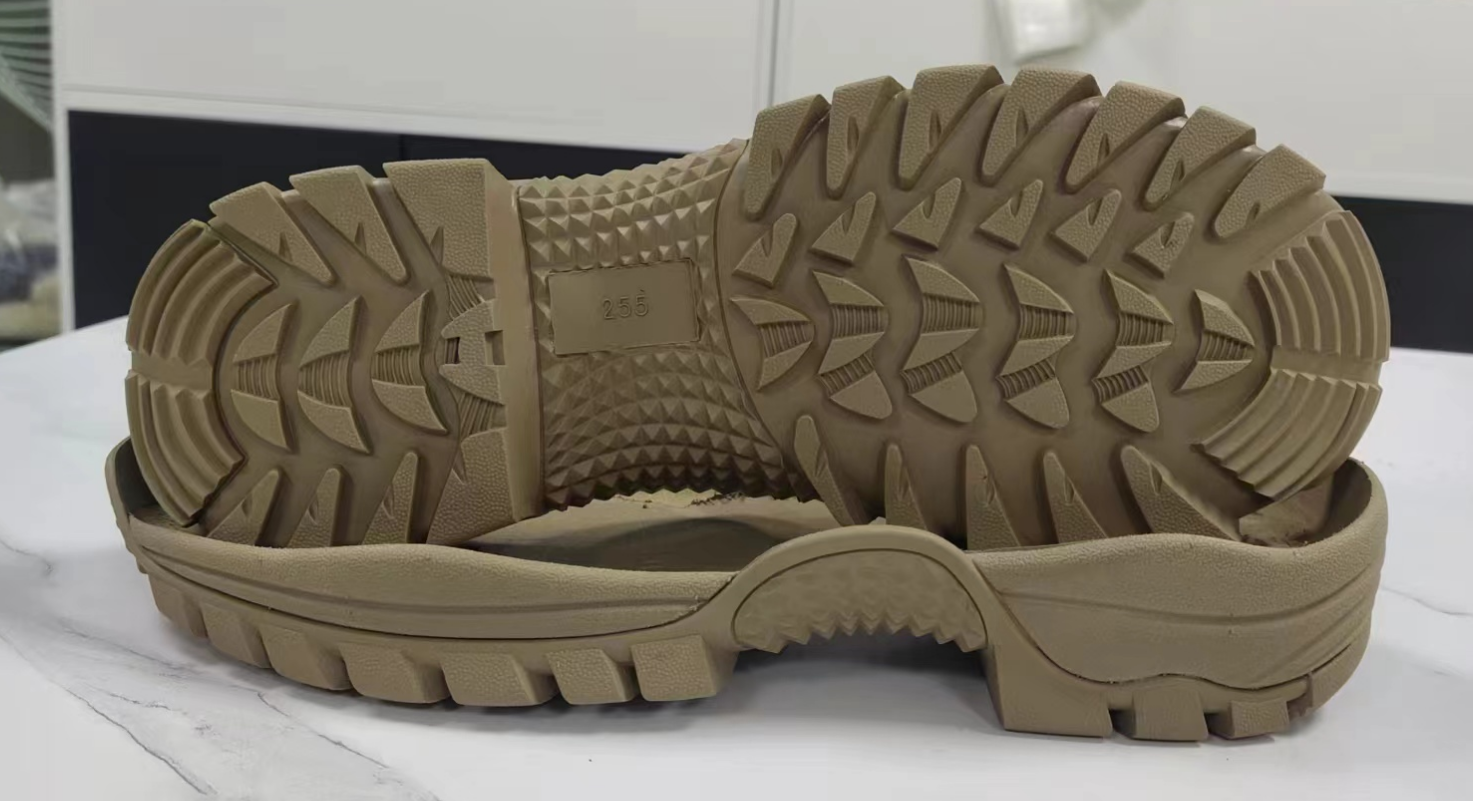
Polyurethane (PU): Widely used in midsole materials, it is lighter and softer than rubber, with high strength, oil resistance, abrasion resistance, and tear resistance. It is an environmentally friendly material that effectively reduces boot weight—combat boots using PU midsoles can weigh as little as 600 grams per shoe, more than 30% lighter than traditional pure rubber-soled military boots. Its disadvantage is that it is prone to hydrolysis and powdering when exposed to air for extended periods. Therefore, a rubber outsole typically wraps around the PU midsole to avoid direct contact with air, and polyether-type polyurethane materials with better hydrolysis resistance are often chosen.
Ethylene-vinyl acetate copolymer (EVA): Primarily used in the midsole foam layer, it is soft, comfortable, and has good resilience, effectively cushioning impacts. It is currently the mainstream midsole auxiliary material. Due to its softness, it usually needs to be paired with a plastic or carbon fiber plate for support to prevent deformation. For example, Salomon's "sandwich sole" uses a plastic plate to support the EVA midsole, with a rubber outsole balancing comfort and stability.
Composite protective materials, including Kevlar, carbon fiber, and steel plates, are primarily used for puncture-resistant and support layers. Kevlar puncture-resistant layers can absorb over 45J of puncture energy, while steel plate puncture-resistant layers can withstand pressure exceeding 270 pounds, effectively resisting punctures from sharp objects while maintaining lightweight construction and not adding extra weight to soldiers.
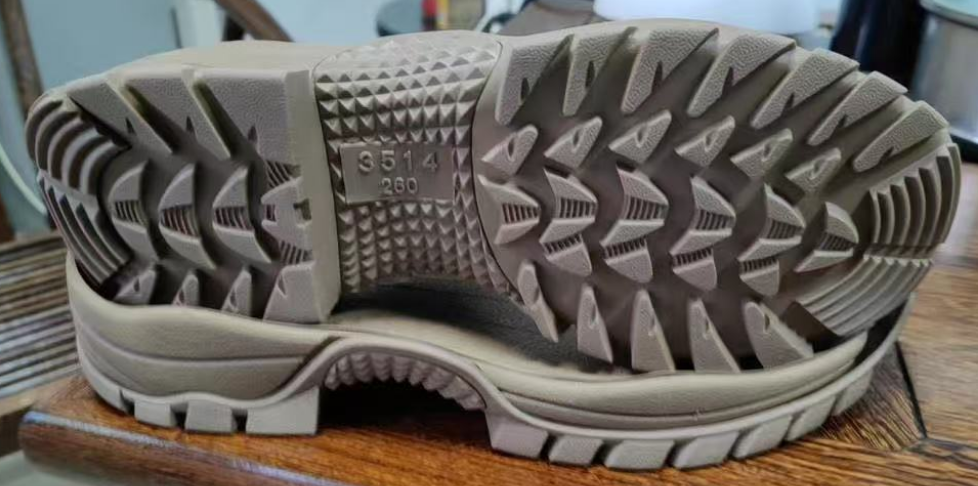
III. Core Testing Standards for Military Footwear and Combat Boot Soles The performance of military footwear and combat boot soles must pass rigorous standardized testing before being used in combat. These testing standards cover multiple dimensions, including abrasion resistance, slip resistance, puncture resistance, impact resistance, and environmental tolerance, and are divided into three categories: international standards, national standards, and military-specific standards, ensuring the reliability and stability of the soles in extreme environments. The following is an analysis of the most core and commonly used testing standards:
(I) International Standards: Globally Applicable Basic Performance Tests
International standards are mainly formulated by the International Organization for Standardization (ISO), the American Society for Testing and Materials (ASTM), and the European Committee for Standardization (CEN). These are the basic standards followed by military enterprises worldwide. Core testing items include:
ASTM F2413-18 (American Standard): The core test is puncture resistance. It specifies that the puncture-resistant layer (steel plate or composite plate) of the sole must withstand more than 270 pounds of pressure. It also covers basic properties such as impact resistance and abrasion resistance. It is one of the core testing standards for combat boot soles used by the US military and many Western countries, and is widely used in the testing of combat boots for extreme environments.
1. ISO 20347:2022 (International Standard): Personal Protective Equipment – Footwear: Basic requirements. It covers core properties of soles such as abrasion resistance, slip resistance, puncture resistance, and flexural strength. The slip resistance test uses a glycerin solution to simulate oily surfaces, which is closer to real combat scenarios. It is a globally applicable basic testing standard. 2.
3. ISO 13287:2019 (International Standard): Test methods for the anti-slip properties of footwear. This standard uses the pendulum method to test the coefficient of friction (COF) of the sole, specifying the threshold values for the COF under different conditions. The requirements for testing in wet and oily environments are more stringent, making it a core international standard for evaluating the anti-slip performance of footwear soles.
ISO 17707:2018 (International Standard): Test methods for the flexural fatigue resistance of footwear outsoles. This standard tests the durability of footwear soles after repeated bending, requiring that the soles not crack or delaminate after 100,000+ cycles of bending, ensuring stability for long-term military use.
(II) National Standards: Specialized Tests Tailored to Domestic Military Industry Needs my country has established clear national standards (GB) and military standards (GJB) for the soles of military footwear and combat boots. Considering the characteristics of my country's geographical environment (plateaus, jungles, deserts, cold regions, etc.), these standards strengthen the testing of extreme environment tolerance. Core standards include:
GB 21148-2020 "Foot Protection - Safety Shoes": A mandatory national standard applicable to the soles of military training shoes and duty shoes. It specifies core indicators such as abrasion resistance, slip resistance, puncture resistance, and impact resistance. Among these, the slip resistance requirements include a wet friction coefficient of the ceramic plate ≥0.3, puncture resistance dynamic impact ≥1100N (cone angle 30°), and sole bonding strength ≥4.0N/mm. This is the basic testing standard for domestic military footwear soles.
GJB 7512-2012 *General Specifications for Military Special Footwear*: A military-specific standard developed for combat boot soles, covering specialized tests such as high and low temperature cycling, oil resistance, and adaptability to swampy terrain. The high and low temperature cycling test requires no cracking after 5 cycles from -40℃/4h to 55℃/4h, and a swampy terrain adhesion force ≥300N, meeting my country's operational needs in extreme environments.
GB/T 3903.2-2017 *Footwear—Test Methods for Whole Shoes—Abrasion Resistance*: Uses the Taber method to test sole abrasion resistance, specifying an abrasion loss ≤150mm³ under an H18 abrasion wheel and a 1kg load, ensuring the durability of the sole during high-intensity training and combat, and preventing rapid wear leading to protective failure.
QB/T 2882-2019 "Low-Temperature Flexural Resistance Test Method for Footwear Uppers": This standard tests the flexural resistance of military footwear soles in cold-weather environments at -30℃, requiring ≥50,000 flexes without cracking to prevent brittleness and cracking in low-temperature conditions.
(III) Detailed Explanation of Core Test Items Regardless of international or domestic standards, core test items revolve around practical combat needs, focusing on the following six dimensions, each with clear indicator requirements and test methods:
Abrasion Resistance Test: Using a Taber abrasion tester with specified grinding wheels, loads, and speeds, the abrasion amount of the sole is tested. The core indicator is abrasion amount ≤150mm³ (GB standard). Lower abrasion amount indicates better abrasion resistance, ensuring the sole can withstand long-term marching and off-road wear, preventing premature damage. The main testing equipment is the TABER5135 abrasion tester, equipped with an H22 grinding wheel, and adjustable weights from 0.5-2kg.
Anti-slip performance test: Using the pendulum method or traction platform method, different road surface environments such as dry, wet, and oily conditions are simulated to test the coefficient of friction (COF) of the sole. The core indicator is a wet COF ≥ 0.3 (GB standard). EU SRC-level anti-slip requirements require simultaneous testing in both ceramic plate + soap solution and steel plate + glycerin scenarios to ensure soldiers do not slip when walking or running on various road surfaces, avoiding accidental injuries. The testing equipment includes a SATRA STM603 anti-slip performance testing platform with an adjustable incline of 0-45° and a force measurement accuracy of ±0.5N.
Puncture resistance performance test: Using a dynamic puncture resistance tester, the protective capability of the puncture-resistant layer of the sole is tested at a specified cone angle (30°) and impact energy. The core indicators are a dynamic impact ≥ 1100N (GB standard) and a puncture energy absorption value of ≥ 45J for the Kevlar puncture-resistant layer, ensuring the sole can withstand punctures from sharp objects such as nails, gravel, and bamboo skewers, protecting foot safety. The testing equipment used was a ZD-9801 dynamic puncture resistance tester, with an impact energy of 0-120J and an accuracy of ±0.5%.
Bending resistance testing: A Ross bending tester or a whole-shoe bending tester was used at a specified angle (90±1°) and frequency to test the sole's condition after repeated bending. The core indicator was ≥50,000 bends without cracking (GB standard). Combat boots have higher requirements; some models need to pass 80,000 bend tests to ensure that the sole does not crack or delaminate after prolonged walking and running, maintaining structural integrity. The testing equipment used was a GT-7012-S whole-shoe bending tester, with a frequency of 1.0±0.1Hz and an adjustable angle of 0-45°.
Environmental tolerance testing: This includes multiple tests such as high and low temperature resistance, oil resistance, waterproofing, and salt spray testing. The high and low temperature cycling test requires five cycles from -40℃ to 55℃ without cracking; the oil resistance test requires a volume change rate of ≤±5% after 24 hours of immersion in #0 diesel fuel; the waterproofing test requires a hydrostatic pressure ≥8kPa; and the salt spray test requires metal components (such as puncture-resistant steel plates) to pass a salt spray test for 96 hours with a salt spray level ≥9, ensuring the sole maintains stable performance in extreme environments and adapts to the needs of combat in different regions. Testing equipment includes a low-temperature brittleness test chamber, a salt spray corrosion chamber, and a breathability and moisture permeability meter.
Shock absorption and energy return testing: Using a foot pressure distribution system, the shock absorption effect and energy return rate of the sole are tested. The core indicator is an energy return rate ≥50% (ASTM F1614 standard). The dual-density midsole must meet the structural requirements of hard edges and soft center to ensure effective absorption of impact, reduce leg fatigue in soldiers, and improve sustained combat capability. The testing equipment was the Novel Pedar-X foot pressure distribution system, with a sampling frequency of 100Hz and a sensor density of 4/cm².
IV. Development Trends of Military Footwear Sole Technology With the continuous advancement of military technology, the design and materials of military footwear and combat boot soles are also constantly being upgraded. The core development trends exhibit three main characteristics: First, lightweighting. Through the application of new composite materials (such as carbon fiber and lightweight PU), the weight of the sole is further reduced while ensuring protective performance. For example, the weight of a single shoe in my country's Type 21 combat boot is controlled at around 600 grams, nearly 40% lighter than the Type 07. Second, intelligentization. Some high-end combat boot soles incorporate pressure sensors and shock absorption adjustment modules, which can automatically adjust the shock absorption effect according to terrain and marching speed, monitor foot condition in real time, and reduce the risk of injury. Third, multi-functional integration. Integrating functions such as puncture resistance, slip resistance, anti-static properties, heat insulation, and waterproofing into one unit, adapting to more extreme scenarios while improving comfort and durability, achieving "one sole adaptable to multiple terrains and all scenarios."
Meanwhile, testing standards are constantly being improved to better reflect real combat scenarios. New specialized tests have been added, including swamp desorption, polar low-temperature abrasion resistance, and biochemical protection, further enhancing the reliability and safety of military shoe soles and providing soldiers with more comprehensive foot protection.
Conclusion: Military shoes and combat boot soles, seemingly small components of individual soldier equipment, embody the culmination of military technology and the protection of soldiers' lives. From the precise design of multi-layered composite structures to the rigorous selection of military-grade materials and stringent standardized testing, every step revolves around "real combat needs," ensuring that the soles can withstand extreme battlefield conditions and provide solid support for soldiers' mobility and protection. With continuous technological iteration, military shoe soles will become lighter, more intelligent, and more multifunctional, and testing standards will be further improved, continuously empowering individual combat capabilities in modern warfare and becoming the most reliable "tactical foundation" under soldiers' feet.
Q1: What is the biggest difference between military boot soles and civilian footwear soles?
A: Military boot soles are designed for extreme environment adaptability, all-around protection, and ultra-long durability. Unlike civilian soles that prioritize comfort and aesthetics, military soles use a multi-layered composite structure and military-grade materials to solve real battlefield problems: traction on complex terrain, high-intensity wear resistance, puncture protection, and extreme temperature tolerance. For example, military puncture-resistant layers must withstand over 270 lbs of pressure, and soles must survive 5 cycles from -40°C to 55°C without cracking – requirements far beyond civilian standards.
Q2: What materials are commonly used in military boot soles, and what are their functions?
A: Four main materials are used:
Rubber (outsole) – wear-resistant, oil-resistant, corrosion-resistant.
Polyurethane (PU) (midsole) – lightweight, high resilience, shock absorption.
EVA (midsole foam layer) – soft, comfortable, energy return.
Kevlar / carbon fiber / steel plate (puncture-resistant layer) – high-strength puncture protection with low weight.
Most military boots combine these in a composite structure (e.g., rubber outsole + PU midsole + Kevlar insert) to balance wear resistance, cushioning, and protection.
Q3: How is slip resistance tested for military boot soles, and what are the requirements?
A: Slip resistance is tested using the pendulum method or traction platform method, simulating dry, wet, and oily surfaces to measure the coefficient of friction (COF). According to Chinese national standard GB 21148-2020, the wet COF on a ceramic plate must be ≥ 0.3. The EU SRC rating requires passing tests on both ceramic plate + soap solution and steel plate + glycerin. International standard ISO 13287 is widely used by the US military and NATO, with stricter requirements for wet and oily conditions.
Q4: Can the puncture-resistant layer really stop nails and sharp debris? What standards apply?
A: Yes. The puncture-resistant layer (steel plate or Kevlar composite) must pass dynamic puncture tests. Under ASTM F2413-18, the layer must withstand over 270 lbs (≈1225 N) of pressure. Under Chinese standard GB 21148-2020, dynamic impact with a 30° cone must be ≥ 1100 N. A Kevlar layer can absorb over 45J of puncture energy, effectively protecting against battlefield hazards like nails, bamboo spikes, and sharp gravel.
Q5: Why are military boot soles required to pass high and low temperature cycling tests?
A: Soldiers operate in extreme environments – from Arctic ice fields to desert heat. The temperature cycling test (e.g., GJB 7512-2012: -40°C/4h ↔ 55°C/4h, 5 cycles) ensures the sole material does not crack, soften, or delaminate due to thermal expansion/contraction. Passing this test guarantees that the sole maintains its protective function and structural integrity under sudden temperature changes, preventing non-combat injuries caused by sole failure.
Q6: What does the “multi-layered composite structure” mean in military boot soles?
A: It typically consists of three to four layers from outside to inside:
Outsole – direct ground contact, provides wear and slip resistance.
Midsole – shock absorption and energy return (PU or EVA foam).
Insole – breathability, moisture wicking, foot contour matching.
Special protective layer (optional) – puncture-resistant (steel/Kevlar), insulation (polar boots), or pressure-resistant (tank crew boots).
Each layer has a dedicated function, working together to achieve full protection and adaptability.
Q7: Are military boot soles getting lighter and smarter?
A: Yes. Current trends include:
Lightweighting – using carbon fiber and lightweight PU to reduce weight. For example, China’s Type 21 combat boot weighs only ~600g per shoe, nearly 40% lighter than the previous Type 07.
Intelligentization – some high-end boots integrate pressure sensors and adaptive shock absorption modules that adjust cushioning based on terrain and marching speed, reducing injury risk.
Multi-functional integration – combining puncture resistance, slip resistance, anti-static, insulation, and waterproofing into one sole for “one sole, all terrains.”


