
Views: 0 Author: Site Editor Publish Time: 2026-09-22 Origin: Site


When developing a new shoe sole, many face a common choice:
OEM soles or ODM soles? This article details the differences between OEM and ODM soles and helps you select the development model that best suits your needs.
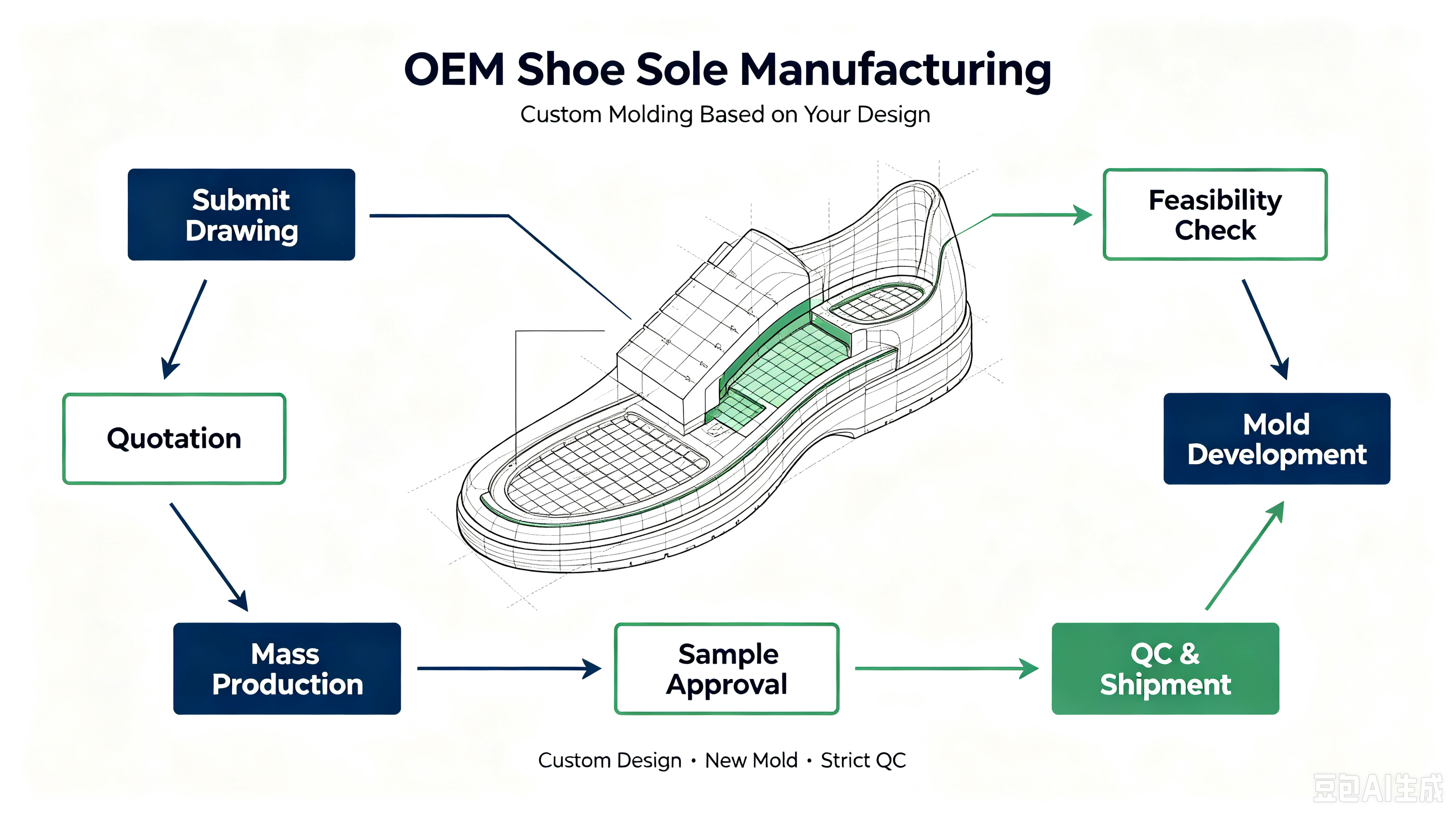
OEM stands for "Original Equipment Manufacturing" (often understood as "manufacturing according to customer specifications"). This means the client provides the sole design, drawings, samples, or detailed technical requirements, and the manufacturer develops and produces the sole according to those specifications.
For example, the client already possesses a sole design, including:
Sole images, 2D drawings, 3D files, physical samples, size ranges, material specifications, hardness requirements, color specifications, and performance standards.
The sole factory is primarily responsible for:
Engineering assessment → 3D modeling/modification → Mold development → Prototyping → Testing → Mass production.
This model is best suited for footwear brands and factories that already have mature product designs.
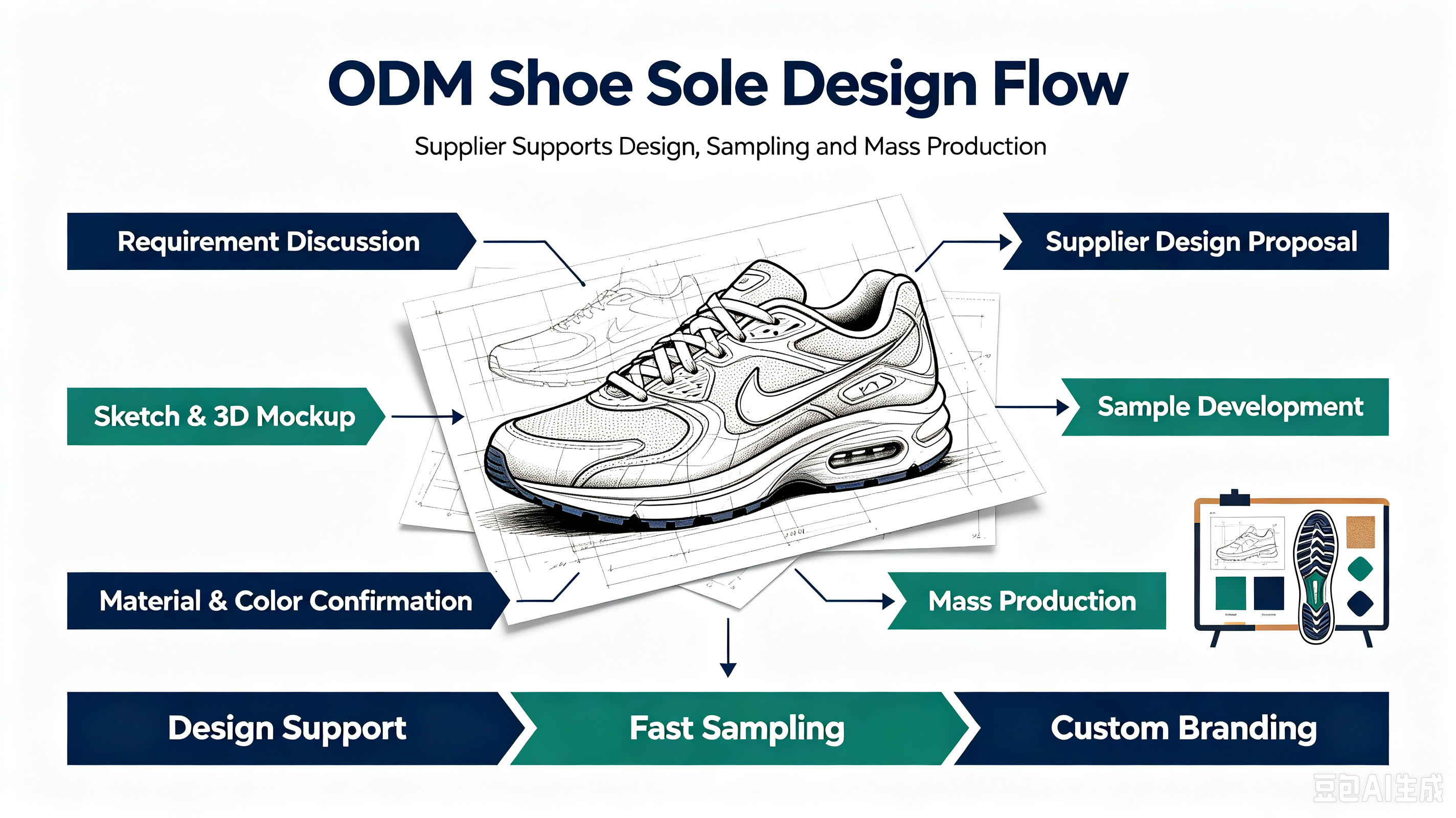
ODM stands for "Original Design Manufacturing."
The key difference from OEM is that the ODM manufacturer is involved in product design and development, not just production.
A client might have only a basic concept rather than complete 2D or 3D designs. In this scenario, the ODM sole manufacturer can step in to handle:
Sole structural design, tread pattern design, material selection, hardness recommendations, product structure optimization, 3D modeling, mold development, sample production, performance testing,
and mass production.
Therefore, ODM is better suited for clients who lack an in-house R&D team or wish to shorten their product development cycle.
Comparison Item | OEM Shoe Soles | ODM Shoe Soles |
Product Design | Provided by the customer | Manufacturer participates in the design |
3D Modeling | Developed based on customer-provided files | Manufacturer can be responsible for 3D modeling |
Material Selection | Specified by the customer or mutually confirmed | Manufacturer provides recommendations |
Outsole Tread Design | Provided by the customer | Manufacturer can participate in the design |
Mold Development | Handled by the manufacturer | Handled by the manufacturer |
Sampling | Handled by the manufacturer | Handled by the manufacturer |
Performance Optimization | Based on customer requirements | Manufacturer participates in optimization |
Customer R&D Capability | Usually strong | Can be limited |
Manufacturer’s Design Involvement | Lower | Higher |
Suitable Customers | Established footwear brands / shoe manufacturers | New footwear brands / product development teams |
Therefore, before starting a project, it is best to clarify the agreements regarding design, molds, intellectual property rights, and development costs.
Examples:
The brand has already completed the product design and is looking for a reliable sole supplier.
The factory has its own design team and needs an external sole factory to handle development and production.
The client already has designers, 3D engineers, product managers, and technical teams.
The sole manufacturer is primarily responsible for production and engineering implementation.
For instance, a client has a sole sample and wants to develop a custom sole with a similar structure.
In this scenario, the OEM model is usually more straightforward.
New brands often lack a full-scale sole R&D team.
ODM suppliers can assist in the development process from concept to finished product.
The client may have market sales channels but lacks manufacturing-side R&D capabilities.
Trading companies can have sole manufacturers assist in product development based on end-customer needs.
If a client wants to launch a new sole series rapidly, ODM can reduce the internal development workload.
"Which is cheaper, OEM or ODM?" There is no absolute answer. The final cost depends on factors such as product complexity, materials, the number of sizes, mold structure, the number of molds, development iterations, testing requirements, and order volume.
For OEM projects, if the client already possesses a mature 3D design, preliminary design work can be reduced.
ODM projects require greater investment from the manufacturer, including product design, 3D modeling, engineering development, and sample optimization.
Consequently, upfront development costs may differ.
However, viewed as a whole project, ODM can potentially help clients reduce their internal R&D investment.
Therefore, when comparing OEM and ODM, one should not simply ask, "How much does a pair of soles cost?"
Instead, the comparison should focus on: "How much money and time are required for the entire product development project?"
Common models include:
The client bears the mold development costs, and mold ownership is determined by the agreement between both parties.
The manufacturer gradually amortizes development costs through subsequent orders.
For long-term partnerships, costs can be negotiated based on factors such as order volume and development investment.
Therefore, it is advisable to confirm the following in writing before the project begins:
Mold costs + mold ownership + usage rights + maintenance responsibilities + handling procedures upon project termination.
This is particularly important for brand clients.
For ODM projects:
Regarding custom sole projects, it is recommended to clearly define the following in the contract or development agreement:
Design copyright, mold ownership, confidentiality obligations, exclusive usage rights, and restrictions on third-party use.
This helps minimize future commercial disputes.
For overseas clients who might otherwise need to coordinate among multiple suppliers:
A one-stop OEM/ODM sole manufacturer integrates these processes, reducing communication steps and improving development efficiency. A one-stop supply chain is usually more convenient, especially for brands that need to continuously develop multiple shoe models.
There is no absolute "better" or "worse" option between OEM and ODM sole development. What truly matters is choosing a partnership model that aligns with your R&D capabilities, product development needs, and business model.
For footwear brands with mature designs, OEM sole development can help you efficiently bring your product designs to life. For new brands, traders, and clients lacking dedicated R&D teams, ODM sole development offers one-stop support—from product concept to mass production.
Whether opting for OEM or ODM, a comprehensive custom sole development process typically includes:
Design → 3D Modeling → Material Selection → Engineering Assessment → Mold Development → T1 Prototyping → Performance Testing → Product Optimization → Final Approval → Mass Production
The total cost depends on the outsole design, material, mold structure, number of sizes, testing requirements, and order quantity. Contact a manufacturer with your design and specifications for an accurate quotation.
Yes. Many custom outsole manufacturers can develop a 3D model based on photos, dimensions, reference samples, or sketches. Additional technical information may be required for accurate development.
The mold-making time depends on the mold type, sole structure, size, tread complexity, and engineering requirements. A manufacturer can provide a more accurate schedule after reviewing the design. As an initial reference, a wooden dummy may take around 3 days and mold making around 10 days; the actual schedule must be confirmed after the technical review.
Common options include EVA, PU, rubber, TPU, TPR, and ETPU. The appropriate material depends on the footwear application, required performance, production process, and target cost.
Yes. A complete size range can normally be developed through size grading. The grading method should be evaluated according to the outsole design and footwear application.


