
Views: 114 Author: Site Editor Publish Time: 2026-01-15 Origin: Site


When it comes to EVA shoe soles, two mainstream technologies dominate the market: Injection EVA (IP EVA) and Compression Moulded EVA (CM EVA). Both boast lightweight, cushioning properties, but their production processes, performance characteristics, and application scenarios differ significantly. Let’s break it down for you!
Production Process Breakdown
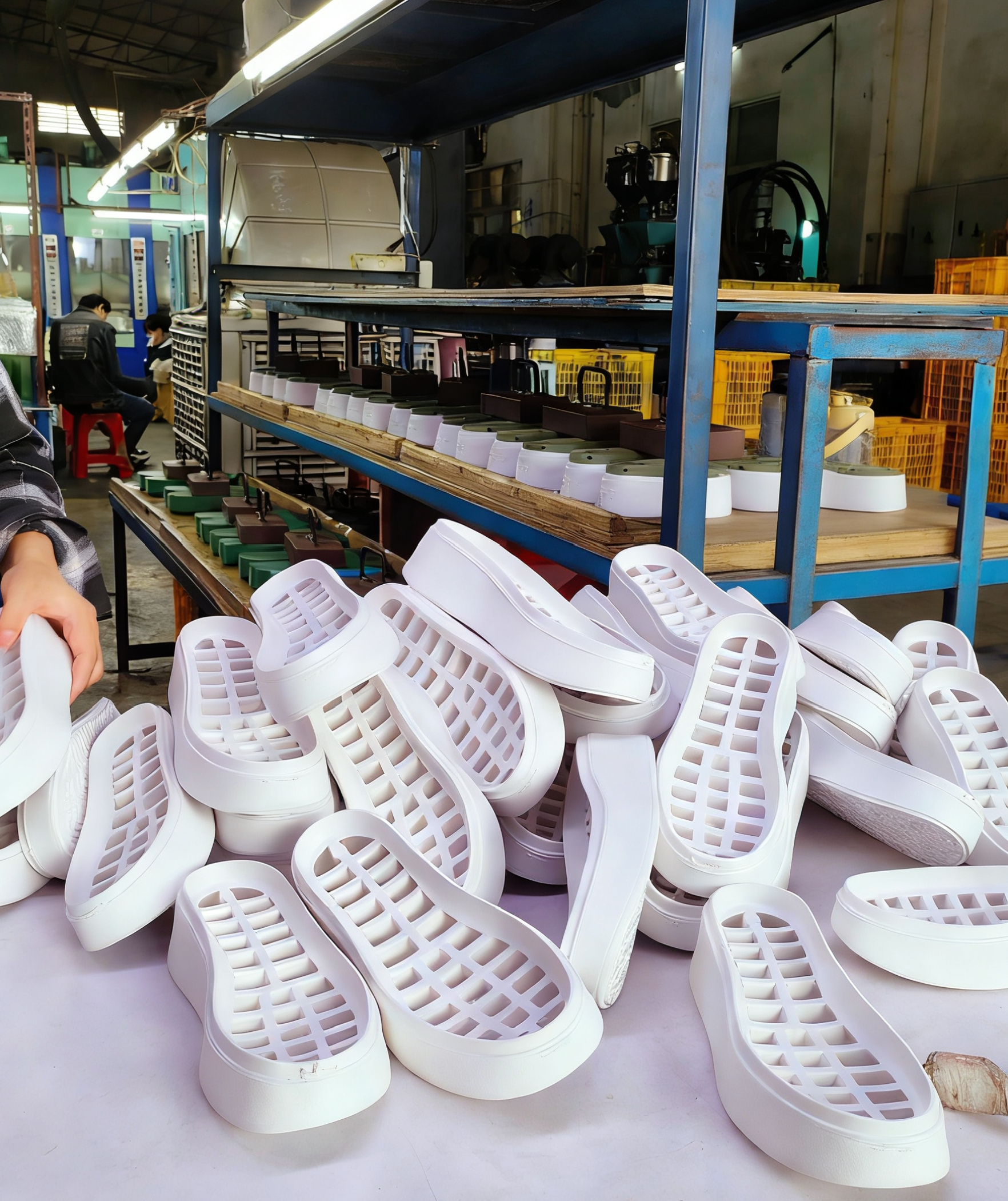
1. Injection EVA (IP EVA)
Material Preparation: Mix EVA pellets, modifiers, and additives at high speed to ensure uniform blending.
Extrusion & Pelletizing: Extrude the mixed material into strands and cut them into uniform pellets for easy feeding.
Injection Molding: Feed the pellets into an injection molding machine, melt them under high temperature and pressure, and inject them directly into a precision mold.
Shaping & Demolding: Cool the mold rapidly to solidify the EVA material, then demold the sole. A sizing last is required to control the sole length precisely.
Finishing: Minimal trimming is needed since the process generates little waste.
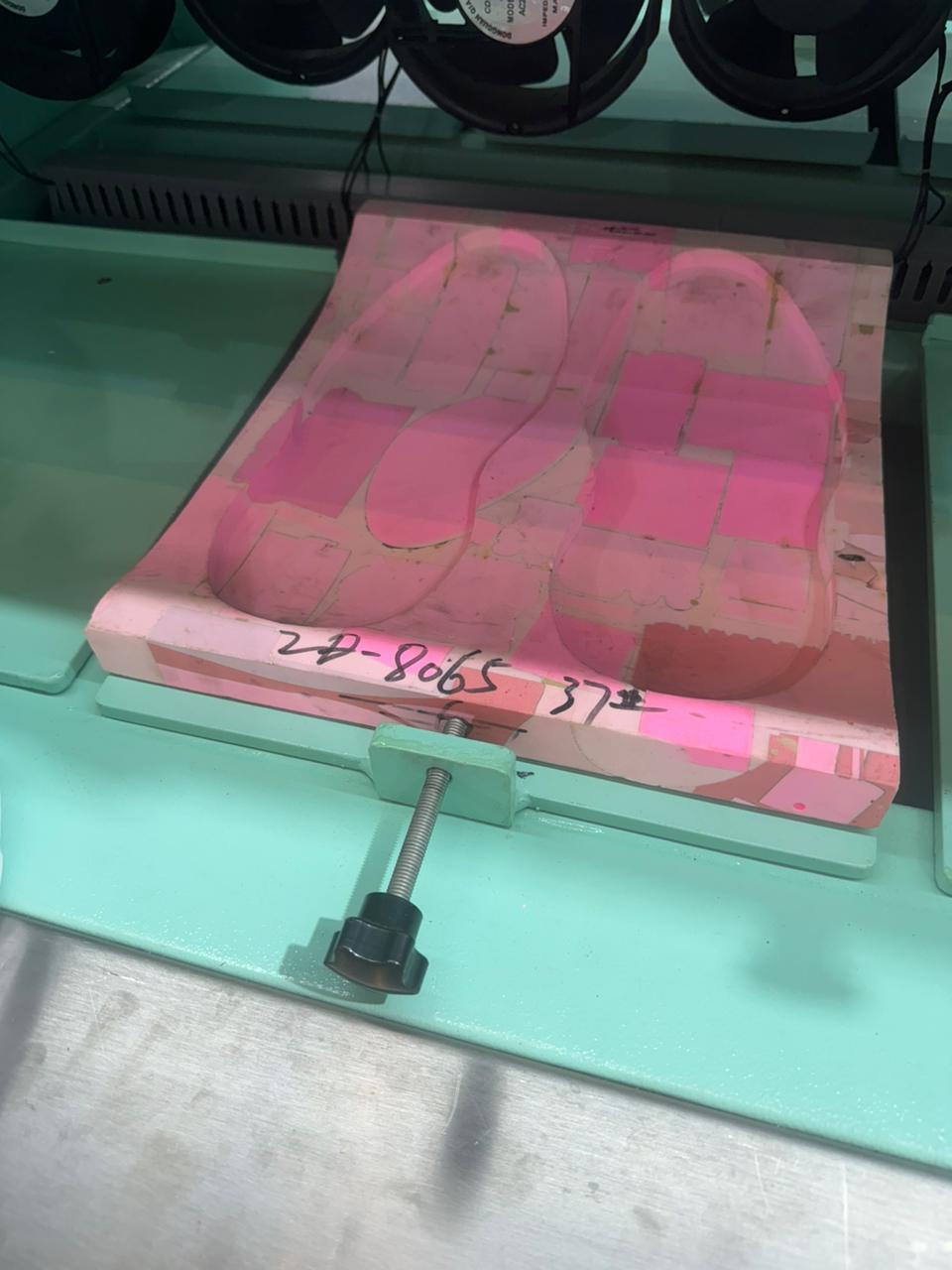
2. Compression Moulded EVA (CM EVA, Prefoaming Secondary Moulding)
Formula Mixing: Blend EVA with foaming agents, cross-linking agents, and functional additives according to strict proportions.
Pelletizing & Weighing: Extrude the mixture into pellets, then weigh fixed amounts of pellets to ensure consistent foam density per sole.
Prefoaming Moulding (Rough Blank): Put the weighed pellets into a primary mold, heat and pressurize to trigger foaming, forming a rough EVA blank with basic shape.
Secondary Moulding (Precision Shaping): Place the rough blank into a more precise secondary mold, reheat and repressurize to refine the shape, texture, and size.
Integrated Bonding (Optional): Use in-mold pressing technology to combine EVA with rubber or TPR outsole layers during secondary molding, eliminating post-molding adhesion steps.
Key Differences of EVA Sole Development : IP EVA Sole vs CM EVA Sole
Design:
IP EVA Sole has design Flexibility Limited (no sharp patterns; simple and shallow textures)
CM EVA Sole has less limitation on design, supports sharp corners, 3D textures, complex contours
Material Compatibility:
IP EVA Sole cannot directly bond with rubber/TPR outsoles
CM EVA Sole can integrate rubber/TPR bottom layers via in-mold pressing
Size Control:
IP EVA Sole relies on sizing lasts; moderate dimensional stability
CM EVA Sole has higher dimensional stability (no need for lasts; precision from secondary mold)
Production Efficiency:
IP EVA Sole has higher output (suitable for mass production, daily output is 200-300 pairs/mould)
CM EVA Sole has lower output than IP EVA (daily output is 70-80 pairs/mould)
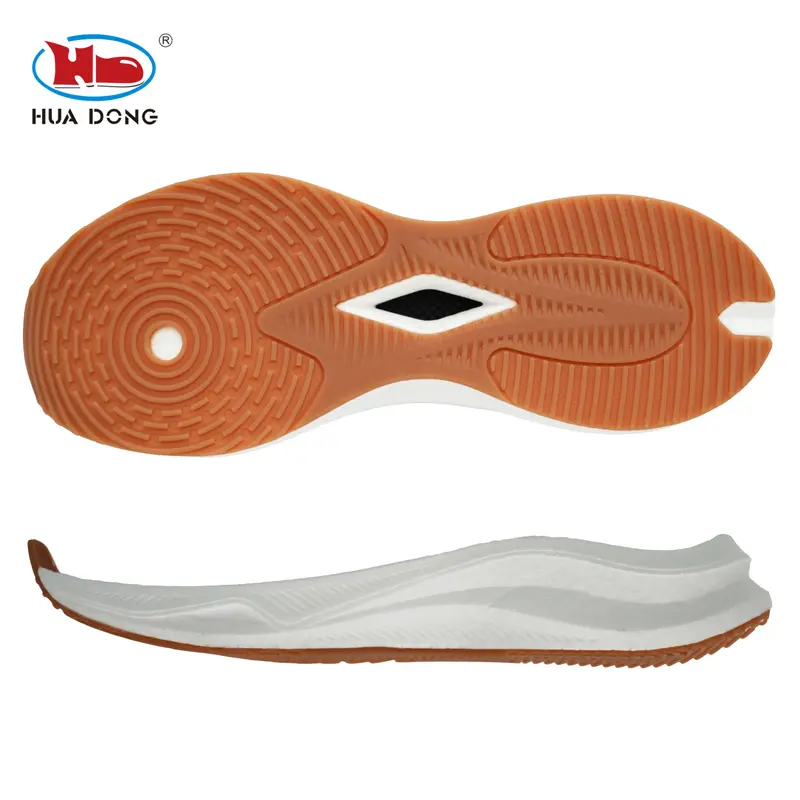
Pros & Cons of Both EVA Sole Type
Injection EVA (IP EVA)
Advantages
• Low material waste and labor costs, ideal for large-scale production
• Stable product quality with consistent cushioning and density
• Fast molding cycle, perfect for meeting high-volume order deadlines
Disadvantages
• High initial machine investment is a barrier for small and medium-sized factories
• Cannot directly bond with rubber/TPR outsoles, requiring additional adhesion processes
• Pattern design is limited to smooth, rounded shapes (no sharp angles)
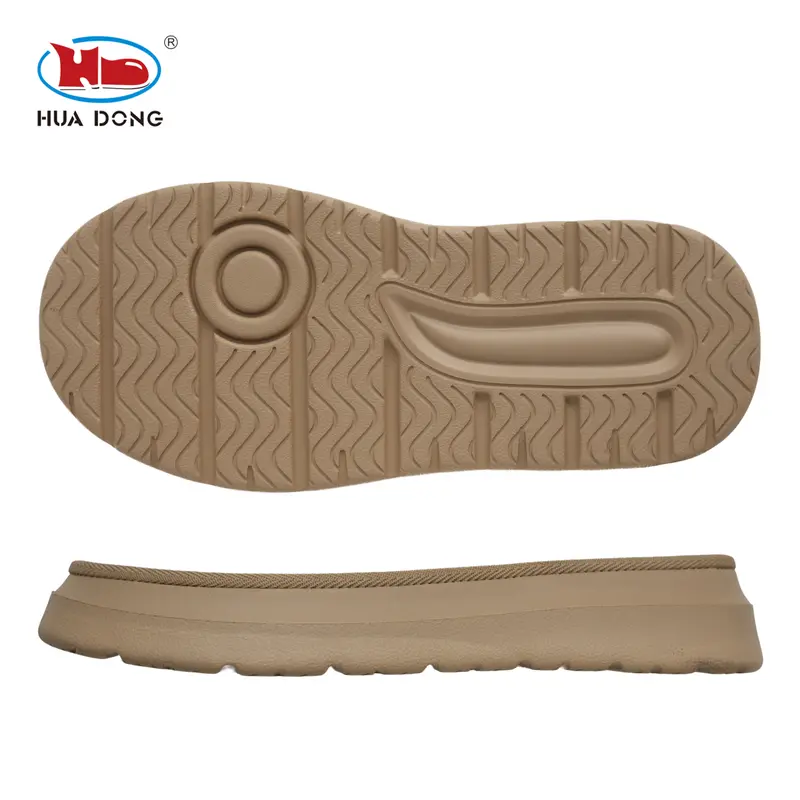
Compression Moulded EVA (CM EVA)
Advantages
• Excellent dimensional stability, ensuring precise fit with shoe uppers
• High design flexibility, supporting customized textures and complex structures
• Integrated in-mold bonding reduces costs of combining with rubber/TPR layers
• No need for sizing lasts, simplifying the production process
Disadvantages
• High mold costs, especially for customized designs with complex shapes
• Lower production efficiency, need to double the sole mould for more-volume orders
• Higher unit cost due to longer molding cycles and more material waste
How Shoe Factories Choose the Ideal EVA Sole?
1. Order Volume: Choose IP EVA for large-volume orders (10,000+ pairs) to leverage its cost and efficiency advantages; opt for CM EVA for small-batch, customized orders.
2. Product Design: If your shoes require sharp patterns, 3D textures, or integrated rubber/TPR outsoles (e.g., hiking shoes, fashion sneakers), CM EVA is the better choice. For simple designs (e.g., casual slippers, basic running shoes), IP EVA suffices.
3. Budget Constraints: If initial capital is limited, CM EVA has lower mould investment; for long-term mass production, IP EVA offers better cost-effectiveness.
4. Quality Requirements: For products demanding strict size consistency (e.g., professional sports shoes), CM EVA is more reliable; IP EVA meets quality standards for daily casual shoes.
Q&A: Below are some common Question to help you choose the right EVA sole!
Q1: What is the main difference from both sole appearance ?
A2: IP EVA sole has more smooth and glossy appearance, there is no air pins on IP EVA sole, while CM EVA sole has small pins especially in the corner of texture, and CM EVA sole has more matt finishing.
Q2: Which type of EVA sole has lighter weight, IP EVA vs CM EVA?
A2: The weight of the both EVA soles can be adjusted according to the ratio and material density, but generally speaking, IP EVA soles will be slightly heavier than CM EVA soles because most CM EVA soles have a lower density, in this case, people use more CM EVA sole for running shoes.
Q3: How do we balance design flexibility and production cost when selecting EVA soles?
A3: For most shoe factories, a mixed strategy works best: use IP EVA for high-volume, simple-design products to control costs, and use CM EVA for customized, high-margin products (e.g., premium sneakers, outdoor shoes) to meet market demand for unique designs. You can also negotiate with HuadongSoles to optimize mold costs for CM EVA batch production.
Contact us for custom EVA sole solutions tailored to your production needs!


