
Views: 6 Author: Site Editor Publish Time: 2026-10-05 Origin: Site


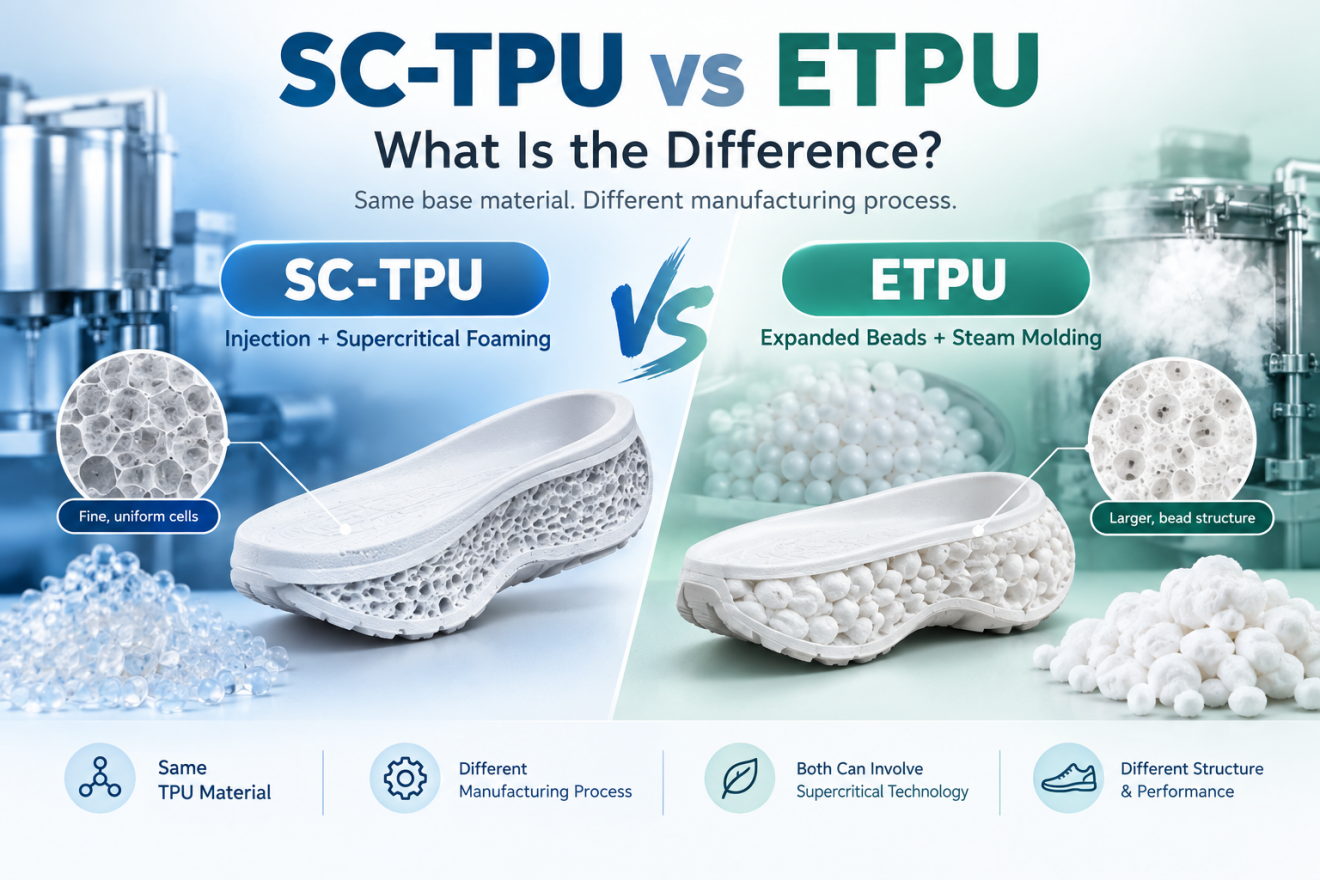
In the development of lightweight and high-performance footwear, SC-TPU and ETPU are two terms that are often mentioned together.
Because both are based on TPU (Thermoplastic Polyurethane) and can use supercritical fluid foaming technology, they are sometimes treated as the same material or the same production process.
However, they are not exactly the same.
The key difference is not simply the TPU material itself. It is mainly related to how the TPU is foamed, formed, and manufactured into a footwear component.
Terminology note: In this article, SC-TPU refers to supercritical-fluid-assisted injection foaming of TPU. Commercial terminology varies, so confirm the exact process with the supplier. ETPU refers to expanded TPU beads; steam-chest molding is common, but specialized grades can also use other forming methods.
In simple terms:
SC-TPU → injection + supercritical foaming process
ETPU → expanded TPU beads + bead molding (commonly steam)
Understanding this difference is important when discussing material selection, tooling, machinery, prototype development, and mass production.
SC-TPU generally refers to supercritical fluid foamed TPU, where supercritical fluids such as CO₂ or N₂ are used as physical blowing agents during the foaming process.
Instead of chemically creating gas inside the material, a supercritical fluid is introduced into the TPU under controlled temperature and pressure conditions.
The TPU can then be processed through an injection-based foaming process to create a lightweight cellular structure.
A simplified process can be described as:
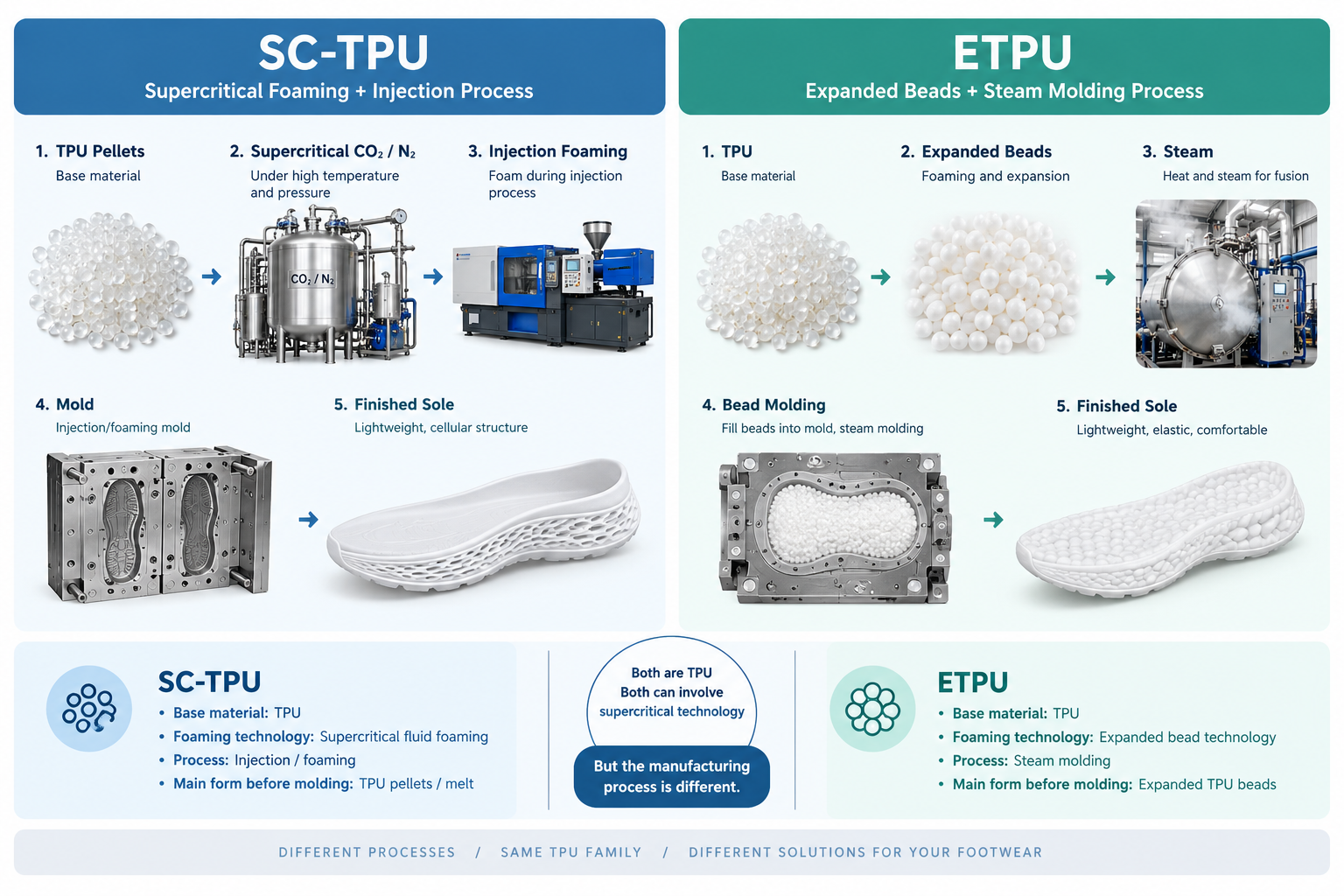
TPU raw material → melting → supercritical fluid mixing under pressure → injection into the mold → pressure-drop-induced cell nucleation and growth → cooling → SC-TPU component
The exact process parameters depend on the material formulation, equipment, mold design, foaming system, and required density.
This technology can be used to develop lightweight and elastic components for footwear, including midsoles and other cushioning structures.
ETPU stands for Expanded Thermoplastic Polyurethane.
Unlike a direct injection foaming process, ETPU is commonly supplied in the form of expanded TPU beads or particles.
These beads have already undergone an expansion process before they enter the final molding stage.
The expanded beads are then placed into a mold and commonly formed using steam molding.
A simplified process is:
TPU raw material → bead production → expansion → expanded TPU beads → steam molding → footwear component
During steam molding, heat and steam cause the expanded beads to soften and bond together inside the mold, forming the final shape.
This is why ETPU footwear components are often associated with bead molding rather than direct injection foaming.
The easiest way to understand the difference is to look at the manufacturing route.
| Item | SC-TPU | ETPU |
|---|---|---|
| Base material | TPU | TPU |
| Foaming technology | Supercritical fluid foaming | Expanded bead technology |
| Typical form before final molding | TPU pellets / melt | Expanded TPU beads |
| Main forming process | Injection / foaming | Steam molding |
| Mold concept | Injection/foaming mold | Bead molding mold |
| Production principle | Foam the TPU during processing | Mold pre-expanded TPU beads |
| Common footwear application | Lightweight midsoles and components | Lightweight cushioning components |
| Key manufacturing focus | Injection, pressure, temperature, cell structure | Bead expansion, steam, bead fusion, mold filling |
The important point is:
SC-TPU and ETPU can both use supercritical technology, but the final manufacturing process is different.
There are several reasons why footwear professionals may confuse SC-TPU and ETPU.
Both technologies start from thermoplastic polyurethane.
Therefore, when discussing material properties such as elasticity, resilience, abrasion resistance, and density, there can be considerable overlap.
But the same base polymer does not mean the same processing technology.
Supercritical CO₂ or N₂ can be used in TPU foaming technology.
This is one reason the terminology can become confusing.
However, “supercritical” describes the foaming technology or physical blowing method; it does not automatically mean that the final product is ETPU.
ETPU is generally understood as expanded TPU beads that are subsequently molded.
SC-TPU can refer to a TPU material/process that is foamed directly through a supercritical fluid-assisted process.
Both technologies can produce lightweight, highly elastic footwear components.
From the outside, two midsoles may look very similar.
But internally, their:
Cell structure
Density distribution
Expansion behavior
Processing method
Mold requirements
Production equipment
can be different.
Therefore, looking only at the finished sole is not enough to determine which manufacturing process was used.
For SC-TPU, the TPU is processed in an injection or similar molding system.
A simplified production sequence is:
TPU pellets are fed into the processing system.
The TPU is heated and plasticized.
A supercritical fluid, such as CO₂ or N₂, can be introduced into the polymer under controlled pressure and temperature.
The pressurized polymer-gas mixture is injected into the mold cavity.
The pressure drop during injection initiates cell nucleation. Gas expansion forms the cellular structure as the cavity fills and the material cools.
After the material reaches the required shape and stability, the footwear component is removed from the mold.
The actual process can be considerably more complex, especially when controlling density, cell size, expansion ratio, surface quality, and dimensional stability.
The ETPU process is different because the TPU is first converted into expanded beads.
A simplified sequence is:
TPU is processed into small particles or beads.
The beads are expanded using a controlled foaming process.
Supercritical CO₂ or other physical foaming technologies may be involved depending on the specific material and manufacturing system.
The result is lightweight TPU beads with a cellular structure.
The expanded beads are filled into a mold.
Steam and heat are used to soften and fuse the beads together.
After molding and cooling, the finished footwear component is removed from the mold.
This bead-based process is one of the most recognizable characteristics of ETPU production.
The difference in manufacturing process also means that the mold design and production considerations are different.
For SC-TPU injection foaming, the mold needs to work with the relevant injection and foaming process.
Important considerations may include:
Injection conditions
Material flow
Expansion behavior
Venting
Pressure
Temperature
Density distribution
Dimensional stability
For conventional steam-molded ETPU, the mold must accommodate expanded beads and allow steam and heat to reach the material effectively. Other ETPU forming routes require tooling matched to their heating and consolidation method.
Important considerations can include:
Bead filling
Bead distribution
Steam penetration
Venting
Fusion between beads
Final expansion
Mold release
Dimensional control
Therefore, a mold designed for an ETPU bead-molding process cannot simply be treated as an ordinary injection mold for SC-TPU.
There is no single answer.
The appropriate technology depends on the footwear design, required density, cushioning characteristics, production equipment, material formulation, mold structure, production volume, and other technical requirements.
Instead of asking:
“Is SC-TPU better than ETPU?”
it is often more useful to ask:
“Which manufacturing process is more suitable for this footwear construction?”
For example, if a project requires a direct injection-based foaming process, SC-TPU may be considered.
If the project is based on pre-expanded TPU beads and steam molding, ETPU is the relevant manufacturing route.
The two technologies should therefore be evaluated based on the complete production system rather than only the material name.
One simple way to remember the difference is:
SC-TPU
TPU + supercritical foaming + injection/forming
while:
ETPU
TPU + expansion into beads + bead molding (commonly steam)
Both are related to lightweight TPU technology, but the production route is different.
This difference affects not only the material structure, but also the equipment, molds, process parameters, production method, and development considerations.
When developing a new lightweight TPU sole, it is important to clarify the process at the beginning of the project.
Before discussing the mold or quotation, it is useful to confirm:
Is the material SC-TPU or ETPU?
Is the TPU supplied as pellets or expanded beads?
Is the production process injection foaming or steam molding?
What density is required?
What hardness is required?
What rebound or cushioning performance is expected?
What is the target shoe construction?
Is the component a midsole, outsole, or integrated sole?
What are the required dimensions and tolerances?
What production equipment will be used?
These details can significantly affect the mold design and development process.
SC-TPU and ETPU are both important technologies for developing lightweight TPU footwear components.
They share the same basic TPU material family, and supercritical fluid technology can be involved in both types of technology.
However, they should not be treated as exactly the same process.
The simplest distinction is:
SC-TPU focuses on supercritical fluid foaming during an injection/forming process, while ETPU uses pre-expanded TPU beads that are subsequently formed through bead molding, commonly with steam.
For footwear developers, understanding this difference can help avoid confusion when discussing materials, machinery, molds, prototypes, and mass production.
At Huadong Holdings, we focus on sole material innovation and outsole mold development, working with footwear partners to explore different material technologies and manufacturing possibilities.
If you are developing SC-TPU, ETPU, or other lightweight footwear components, we welcome discussions about the material, mold structure, prototype development, and production process for your project.
BASF Infinergy processing information distinguishes ETPU grades for steam-chest and heat-press molding. Trexel MuCell process information explains cell nucleation as a pressurized polymer-gas mixture enters the mold. Confirm grade-specific processing guidance with your material and equipment suppliers.
Both belong to the TPU material family, but the terms describe different aspects of processing. Here, SC-TPU means direct supercritical-fluid-assisted injection foaming, while ETPU means expanded TPU beads consolidated into a component.
No. Steam-chest molding is common, but some specialized ETPU grades support heat-press or other forming methods. Match the material grade, equipment and tooling to the approved process.
The process name alone cannot determine cushioning. Compare samples at the intended density and geometry, using agreed tests for rebound, compression set, fatigue and dimensional stability.
They generally require different tooling concepts. Injection foaming must control melt flow and gas expansion; bead molding must manage filling and bead fusion. Confirm compatibility with the equipment supplier before adapting a mold.
Provide the sole drawing or 3D model, size range, target density and hardness, cushioning requirements, tolerances, expected volume, material grade and available production equipment.


