
Views: 6 Author: Site Editor Publish Time: 2026-11-07 Origin: Site


Tennis shoe sole development starts with the playing surface and the way a player moves. Repeated stops, side steps and changes of direction place different demands on footwear from steady forward running. A useful design must balance traction, wear resistance and a stable platform without making the forefoot unnecessarily stiff.
The sole assembly contains several parts with different jobs. The outsole contacts the court and provides the tread. The midsole manages cushioning and helps define the platform geometry. A midfoot support component, where used, controls twisting. These parts must work with the upper to keep the foot positioned over the sole during lateral movement.
For footwear buyers, a convincing sample is more than an attractive bottom pattern. The development brief should connect the intended court, player profile and durability target to measurable requirements.
Hard courts place strong abrasion demands on an outsole. Designs commonly use durable rubber and multidirectional or modified herringbone patterns. Reinforcement in heavily worn areas can help, but adding rubber everywhere also adds weight. Evaluate wear patterns from representative players before deciding where extra coverage is useful.
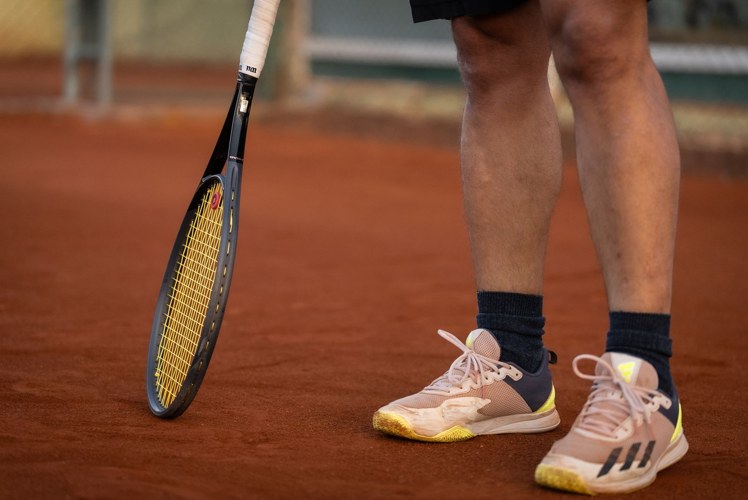
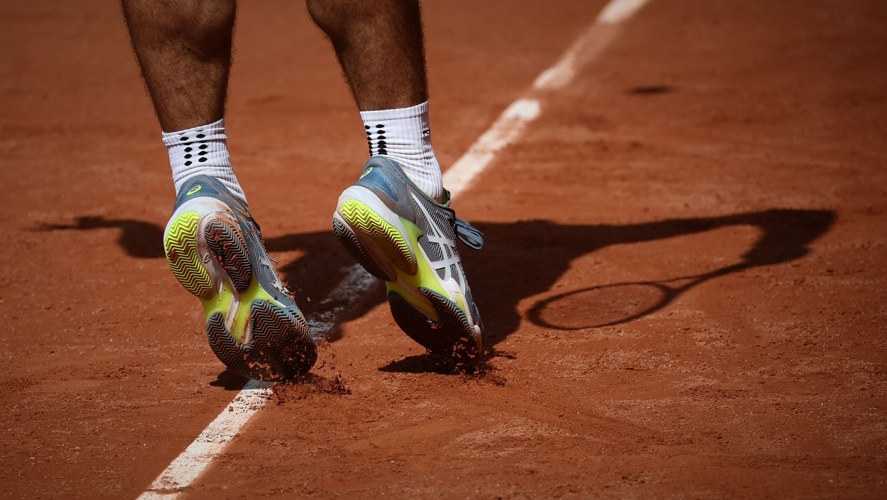
Clay court shoes commonly use a more continuous herringbone pattern. The grooves help manage loose surface material while supporting controlled movement. A clay design should be evaluated on clay, because its performance cannot be inferred from a smooth indoor-floor test.
Grass court footwear uses a different approach, often with closely spaced small protrusions. Check the venue rules and surface requirements before selecting a design. An all-court label can be convenient, but it does not mean that one outsole performs identically on every surface.
The ITF and LTA both treat the court surface as an important footwear consideration. Surface-specific evaluation should therefore be part of sample approval rather than an assumption made from the appearance of the tread.
Rubber formulation influences abrasion resistance, flexibility and friction, but a hardness reading alone does not describe the whole outsole. Two compounds with similar hardness can behave differently because of their polymer blend, fillers and cure condition. Specify performance targets and compare samples under the same conditions.
Lateral stability also depends on geometry. The width of the platform, outsole coverage around the edge, midsole shape and upper support all affect how the foot is held during a sideways stop. A soft midsole is not automatically a comfortable or stable court platform.
Flex grooves should allow useful forefoot bending without creating weak sections. Toe-drag zones may require additional protection, while the midfoot can need more torsional control. These requirements should be considered together when deciding material thickness and mold details.
For development teams, the practical question is whether the complete shoe remains controlled through repeated court movements. Component tests are valuable, but they cannot replace assessment of the assembled footwear.
Begin with a written specification covering the intended surface, size range, target weight, material route and expected use. Ask the supplier to identify the proposed molding process and the features that may be difficult to fill, demold or bond consistently.
A rubber outsole requires a validated molding and curing process. Trial parts should be checked for incomplete filling, trapped air, dimensional variation and poorly formed tread edges. The approved sample should also establish the acceptable appearance and fit to the rest of the sole assembly.
Validation should address abrasion, repeated flexing, bond strength and relevant traction conditions. Follow this with wear trials on the intended court. Inspect toe wear, sidewall damage, tread loss and any separation between components. Record the test method and conditions alongside the result so future batches can be compared fairly.
Planning a tennis outsole project? Send Huadong your court requirements, drawings or reference samples, size range and expected order volume. A clear brief makes material and tooling discussions more useful from the start.
The outsole is the ground-contact layer. The midsole sits above it and contributes cushioning and platform geometry. Their functions are related, but they are not interchangeable.
Herringbone patterns are common, especially on clay. The exact pattern, compound and construction should still be matched to the court and evaluated in use.
Hardness alone cannot predict service life. Compound formulation, thickness, tread geometry, cure quality and playing conditions also matter.
A material sample can support early screening. Final approval should also consider molded parts, bonding and performance of the complete shoe.


